
Table of Contents
- Introduction
- What Do Frigidaire Dishwasher Error Codes Mean?
- Symptoms That Come With an Error Code
- Common Causes Behind Frigidaire Dishwasher Error Codes
- Safety Warnings Before You Troubleshoot
- Frigidaire Dishwasher Error Codes List
- Frigidaire Dishwasher Error Codes: Flashing Lights (No Display Models)
- Where to Find Your Frigidaire Dishwasher Manual
- Troubleshooting Frigidaire Dishwasher Error Codes: Step-by-Step
- Replacement Parts You Might Need
- Diagnostic System Specs: How the Codes Are Generated
- Warranty Considerations
- Maintenance Tips to Prevent Error Codes
- DIY Tutorial: Clearing an i20 Drain Error
- Conclusion
- FAQs
Introduction
A Frigidaire dishwasher that suddenly stops mid-cycle and flashes a code at you is one of the more common reasons homeowners search for help online. The good news: most Frigidaire dishwasher error codes point to something you can check yourself in under ten minutes — a blocked filter, an unlatched door, or a kinked drain hose — before you ever need to call a technician.
This guide breaks down the full Frigidaire dishwasher error codes list, explains what each one is actually telling you, and walks through troubleshooting Frigidaire dishwasher error codes step by step, including the flashing lights patterns used on older, non-digital models. By the end, you’ll know exactly which codes you can clear yourself with a Frigidaire dishwasher error codes reset, and which ones mean it’s time to bring in a specialist.
What Do Frigidaire Dishwasher Error Codes Mean?
Frigidaire dishwasher error codes are short alphanumeric messages — like i20, i30, CO, UO, or PF — that the control board displays when a built-in sensor detects something outside normal operating conditions, such as slow draining, a leak, an open door, or a power interruption. Each code narrows the problem to a specific system so you can check the right component first.
Symptoms That Come With an Error Code
Before you even read the display, a few signs usually tip you off that a code is coming:
- The wash cycle stops partway through and won’t restart
- Standing water is left in the bottom of the tub after a cycle
- The dishwasher hums or clicks but doesn’t fill or drain
- Lights on the control panel blink in a repeating pattern instead of showing a steady cycle status
- The unit runs a few minutes, then shuts off and won’t respond to button presses
- Water pools underneath or around the front of the dishwasher
If you’re seeing any of these along with a code on the display, work through the matching entry in the code list below before you run another cycle — running the dishwasher again without addressing the fault can make the underlying issue worse.
Common Causes Behind Frigidaire Dishwasher Error Codes
Most Frigidaire dishwasher faults trace back to a handful of root causes:
- Food debris and soil buildup in the fine filter, coarse filter, or sump area, which restricts drainage and trips drain-related codes
- Kinked, pinched, or improperly routed drain hoses, especially after a garbage disposal installation where the knockout plug wasn’t removed
- Door alignment or latch issues, which the control board reads as “door open” even when it looks closed
- Water inlet valve or float switch problems, which can trigger both low-fill and overflow codes
- Power fluctuations, breaker trips, or loose electrical connections, which produce power-failure codes
- Aging control boards or wiring harnesses, more common in units over 6–8 years old, which produce communication or board-level errors
Safety Warnings Before You Troubleshoot
- Always unplug the dishwasher or shut off its dedicated breaker before removing panels, reaching near the pump, or accessing wiring — never work on a live unit.
- If you smell burning plastic, see scorch marks, or notice the unit tripping a breaker repeatedly, stop troubleshooting and contact a qualified appliance technician rather than continuing to run cycles.
- Standing water in the tub can be deeper than it looks and may be hot — bail it out with a cup or towel before opening the filter assembly.
- Never bypass a door-latch or float-switch safety feature to “force” a cycle to run; these exist to prevent leaks, flooding, and electrical hazards.
- If you’re not comfortable with basic electrical or plumbing work, these checks are still safe to attempt, but part replacement (pumps, control boards, wiring) is best left to a professional.
Frigidaire Dishwasher Error Codes List
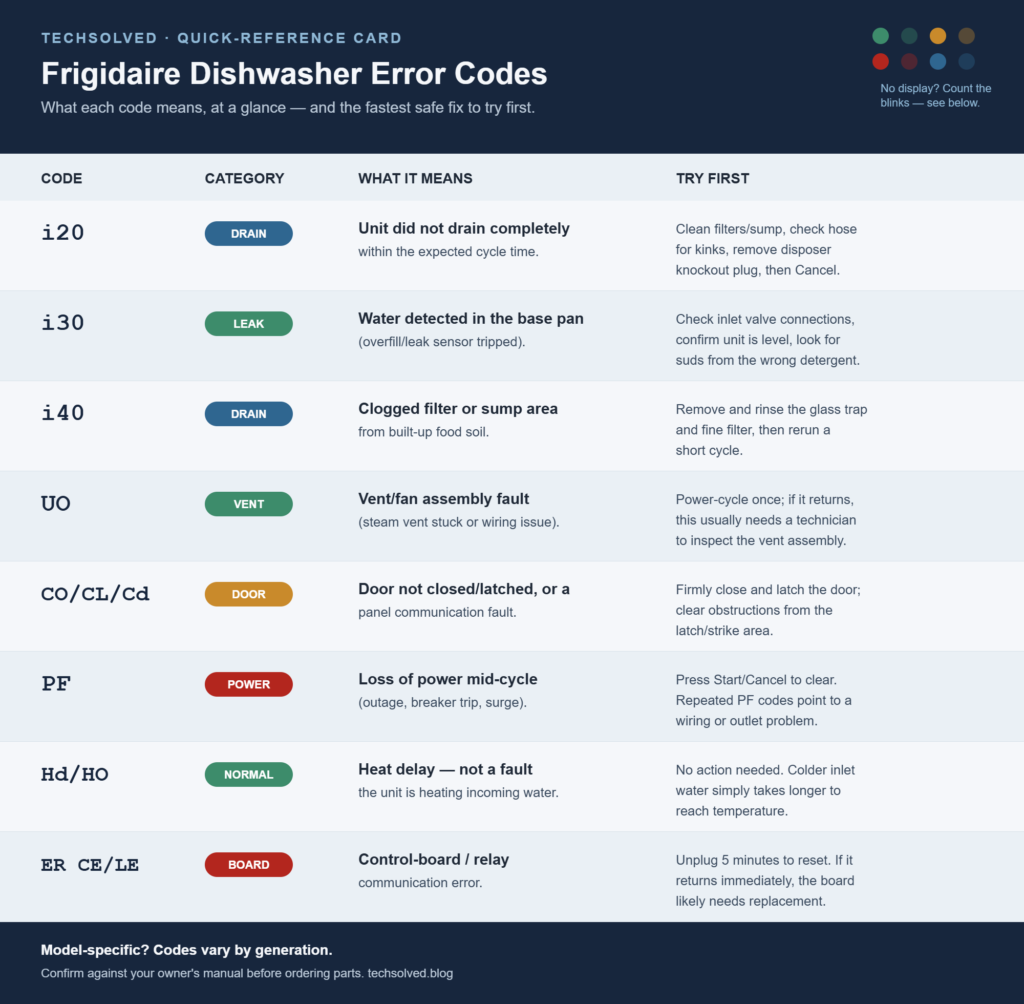
Here’s the core Frigidaire dishwasher error codes list you’ll run into across most digital-display models. Exact letter/number combinations can vary slightly by model year, so always cross-check against your owner’s manual if something doesn’t match.
Frigidaire Dishwasher Error Codes i20
The i20 code means the unit did not drain completely within the time the control board expects. It’s the single most frequently reported Frigidaire dishwasher code. Check that the disposer knockout plug has been removed (if the drain line ties into a garbage disposal), that the drain hose isn’t pinched or blocked, that it sits at least 32 inches above the floor, and that the filters and sump are free of food soil. Clear it by pressing Cancel, or by cutting power at the breaker or unplugging the unit for about 3 minutes.
Frigidaire Dishwasher Error Codes i30
The i30 code indicates the leak/overflow sensor in the base pan has detected water where it shouldn’t be. Start by checking the water inlet valve connections for looseness, confirming the dishwasher is properly leveled front-to-back and side-to-side, and ruling out oversudsing from using dish soap instead of dishwasher-specific detergent. If water keeps appearing under the unit after these checks, the inlet valve or a door gasket may need replacing.
Related code i40 covers a clogged filter or sump specifically — food soil buildup that’s restricting flow. Cleaning the glass trap and fine filter and rerunning a cycle typically clears it.
Frigidaire Dishwasher Error Codes CO
Codes commonly written as CO, CL, or Cd all point to the same underlying issue: the door hasn’t been detected as fully closed and latched, or — on some boards — a communication fault between the door switch and the control panel. Firmly close and latch the door and confirm nothing (a tall dish, a utensil) is blocking it from seating properly. If the code persists with the door clearly latched, the door switch itself may have failed and should be tested or replaced.
Frigidaire Dishwasher Error Codes UO
The UO code (sometimes shown as ER UO or “OU”) points to the vent and fan assembly — the component that vents steam during the dry cycle. You’ll often hear a few clicking sounds right before the code appears. A one-time power cycle occasionally clears it, but a UO code that keeps returning usually means the vent solenoid, wiring harness, or fan motor needs inspection, and on many units that’s a job better handled by a technician since the assembly sits behind the front panel.
Frigidaire Dishwasher Error Codes 4
A standalone “4” isn’t part of Frigidaire’s standard digital-display code set, but on non-digital, light-based models, individual digits are represented by a count of LED blinks rather than printed characters — so a customer might describe seeing “4 flashes” as “error code 4.” If your unit has no text display, skip to the flashing-lights section below and count the blink pattern instead of looking for a printed “4,” and check your specific model’s use-and-care guide, since blink-count meanings differ across Frigidaire’s dishwasher generations.
Frigidaire Dishwasher Error Codes ER
Several Frigidaire dishwasher error codes carry an “ER” prefix, meaning simply “Error,” followed by a two-letter suffix that identifies the failed component — for example, ER CE (communication error between the display board and main control) or ER UO (vent stuck open). Think of the ER-series codes as the board telling you which subsystem failed a self-check. Because these usually involve the main control board or wiring harness rather than something you can rinse out, a persistent ER code that returns after a full power cycle is one of the clearer signs it’s time to loop in a specialist.
Additional Codes Worth Knowing
| Code | Meaning |
|---|---|
| PF | Loss of power during a cycle; press Start/Cancel to clear |
| Hd / HO | Heat delay or heater-on mode — normal, not a fault |
| LO | Low rinse aid |
| LOC | Control lock is engaged |
| PRESS START | Not an error — reminder to close the door within 5 seconds of pressing Start |
Frigidaire Dishwasher Error Codes: Flashing Lights (No Display Models)
Older and budget Frigidaire dishwashers without a text display communicate faults through flashing lights instead of letters and numbers:
- Power failure: the Hi-Temp Wash and Heat Dry lights flash together — press Start/Cancel to stop the flashing.
- Door not closed: pressing Start/Cancel causes the Cycles, Option, and Washing lights to flash; closing the door stops it and the cycle should begin.
- Shorted keypad: the unit drains and the status lights flash in a loop. Cutting power for about 5 minutes sometimes clears this; if the flashing returns immediately, the keypad likely needs replacement.
If your model uses a cluster of indicator lights rather than a screen, count how many times each light blinks in sequence and match that pattern against your owner’s manual — the sequence works the same way a printed code does, just translated into blinks.
Where to Find Your Frigidaire Dishwasher Manual
Your model and serial number are usually printed on a sticker along the inner edge of the door, visible when the door is open. With that number in hand, you can pull the exact use-and-care manual from Frigidaire’s official product support page, which lists the precise code definitions and reset instructions for your specific model — useful since code meanings can shift slightly between model years. [Internal link: How to find your Frigidaire model and serial number]
Troubleshooting Frigidaire Dishwasher Error Codes: Step-by-Step
- Read the exact code on the display, or count the flash pattern if there’s no screen.
- Cancel the current cycle by pressing Start/Cancel, and let the unit sit for a minute.
- Check the door — open, firmly close, and confirm it latches without obstruction.
- Inspect the filters and sump, removing and rinsing the coarse and fine filters under running water.
- Trace the drain hose for kinks, pinches, or an unremoved disposer knockout plug.
- Confirm the unit is level front-to-back and side-to-side using a small level on the tub floor.
- Power-cycle the dishwasher — unplug it or switch off the breaker for 3–5 minutes, then restore power.
- Run a short cycle to see if the code returns; if it does immediately, note the exact code and move to the specific fix above or contact a specialist.
Replacement Parts You Might Need
Depending on which code you’re chasing, these are the parts most commonly involved:
- Drain pump / drain pump motor — for persistent i20 or i40 drain codes
- Water inlet valve — for i30 leak/overflow codes
- Door latch or door switch assembly — for CO/CL/Cd door codes
- Vent and fan (blower) assembly — for UO vent codes
- Float switch — for both low-fill and overflow-related faults
- Main control board — for recurring ER-series or PF codes that survive a full power cycle
Always match the part number to your specific model number rather than ordering by code alone, since the same fault can use different parts across model years.
Diagnostic System Specs: How the Codes Are Generated
Frigidaire’s dishwasher control boards run continuous self-checks during a cycle: water-level sensors, pressure switches, float switches, thermistors, and door/latch switches all report status back to the main board. When a reading falls outside its expected range for a set amount of time — for example, the tub failing to reach a low-water threshold within the allotted drain window — the board logs a fault and displays the matching code (or blink pattern, on non-digital models) instead of continuing the cycle blind. This is a safety-first design: the unit stops rather than risking a flood, a scald, or a burned-out motor.
Warranty Considerations
Most new Frigidaire dishwashers carry a limited one-year parts-and-labor warranty, with some components — like certain electronic control boards — sometimes covered longer under separate terms. Before you open the unit or order parts yourself, check your warranty status using your model and serial number on Frigidaire’s official support site; DIY disassembly on a unit still under warranty can affect coverage, so it’s worth a quick call to confirm before you start unscrewing panels. If the dishwasher is still covered, scheduling an authorized repair is typically the lower-cost path even if the fix seems simple.
Maintenance Tips to Prevent Error Codes
- Clean the fine and coarse filters at least once a month, more often if you run disposal-heavy loads
- Scrape large food debris off dishes before loading rather than relying on the dishwasher to clear it
- Use rinse aid consistently to prevent residue buildup that can affect sensors
- Run a monthly empty cycle with a dishwasher-safe cleaner to clear grease and mineral buildup from the sump and spray arms
- Check the drain hose loop periodically for sagging or pinching, especially after any under-sink plumbing work
- Confirm the unit stays level as your kitchen floor settles over time
DIY Tutorial: Clearing an i20 Drain Error
Since i20 is the code most homeowners encounter, here’s a full walkthrough:
- Unplug the dishwasher or switch off its breaker for safety.
- Open the door and remove the bottom rack to access the tub floor.
- Twist and lift out the filter assembly (coarse and fine filters together, per your model’s release mechanism).
- Rinse both filters under warm running water, using a soft brush to clear trapped food particles from the mesh.
- Inspect the sump area at the bottom of the tub for debris, and wipe it clean.
- Reinstall the filters, making sure they lock back into place — a loose filter is a common cause of repeat drain errors.
- Check the drain hose where it exits the dishwasher and connects at the sink cabinet, looking for kinks or a disposer knockout plug that was never removed.
- Restore power, run a short rinse cycle, and confirm the water drains fully at the end.
If water is still standing in the tub after these steps, the drain pump itself may be obstructed or failing, which typically calls for a technician to access and test.
Conclusion
Most Frigidaire dishwasher error codes are the control board doing exactly what it’s designed to do: catching a small problem — a clogged filter, an unlatched door, a kinked hose — before it becomes a bigger one. Working through the Frigidaire dishwasher error codes list above, trying a proper reset, and following the step-by-step checks will resolve the majority of codes, including the most common ones like i20, i30, and CO. Codes tied to the vent assembly, control board, or repeated ER errors are the ones worth handing off to a professional rather than pushing further on your own.
Ready to get your dishwasher back up and running? Bookmark this guide for the next time a code pops up, and browse more appliance troubleshooting walkthroughs on TechSolved — or reach out to a certified specialist if your code keeps coming back after these steps.
FAQs
What’s the fastest way to do a Frigidaire dishwasher error codes reset?
Press Start/Cancel once to clear most codes, or cut power at the breaker (or unplug the unit) for 3–5 minutes for a full reset. This clears the fault memory, but it won’t fix the underlying cause, so the code will likely return if the root issue (a clog, an open door, etc.) isn’t addressed first.
Why does my Frigidaire dishwasher show an i20 code every few loads?
Recurring i20 codes almost always mean the filters or drain hose are getting re-clogged between cleanings, often from disposal-heavy households. If you’ve cleaned the filters and checked the hose and it still comes back quickly, the drain pump impeller may have debris lodged in it.
What do the ER Frigidaire dishwasher error codes mean?
ER simply stands for “Error,” and the letters after it identify which subsystem failed — for example, ER CE points to a control-board communication fault and ER UO points to the vent assembly. These ER-prefixed codes typically involve electronics or wiring rather than something you can rinse clean, so persistent ones often need a technician.
My Frigidaire dishwasher has no display — how do I read the error?
Watch which indicator lights flash and count how many times each one blinks; the pattern maps to a code the same way printed characters would. Check the flashing-lights section above or your model’s manual for the exact pattern-to-fault mapping.
Is it safe to keep running my dishwasher if it keeps throwing the same code?
No — running additional cycles without resolving the fault can worsen leaks, flood the base pan, or strain the motor and pump. Address the code first, even if that just means a quick filter clean, before starting another cycle.
Can a power surge cause multiple different error codes to appear?
Yes. A surge or unstable power supply can trigger a PF (power failure) code and, in some cases, leave the control board in a state where unrelated codes appear afterward. If codes started right after a storm or outage, a full power-cycle reset is worth trying first.
Do Frigidaire dishwasher error codes mean the same thing on every model?
Mostly, but not always — code definitions can shift slightly between model years and series (standard vs. Gallery vs. Professional). Always confirm against the manual for your exact model number if a fix in this guide doesn’t match what you’re seeing.
When should I stop troubleshooting and call a specialist?
If a code returns immediately after a full power-cycle reset, if you see a burning smell or repeated breaker trips, or if the fix involves the vent assembly, drain pump, or control board, it’s time to call a certified appliance technician rather than continue DIY repairs.
Disclaimer: This article is provided for general informational purposes only and is not a substitute for professional appliance repair advice. Always follow the safety guidance in your Frigidaire owner’s manual, and disconnect power before inspecting any component. If your error code persists, involves electrical or vent-assembly components, or you’re unsure at any step, please contact a certified Frigidaire specialist or appliance repair technician for hands-on diagnosis.