
Table of Contents
- What Does the Samsung 5E Error Mean? (Quick Answer)
- Symptoms of the Samsung 5E Error
- What Causes the Samsung 5E Error
- Safety Precautions Before You Start
- Related Samsung Error Codes
- Where to Find Your Samsung Owner’s Manual
- Step-by-Step: How to Fix the 5E Error
- DIY Tutorial: Emergency Draining and Cleaning the Pump Filter
- Replacement Parts You Might Need
- Installation Specs That Prevent 5E Errors
- Warranty Considerations
- Preventing the 5E Error From Coming Back
- FAQs
- Conclusion & Next Steps
A Samsung washing machine’s 5E (or 5C) error means the machine has detected a drainage problem — it senses that water hasn’t left the drum when it should have. It’s almost always caused by a clogged drain pump filter, a kinked or clogged drain hose, or a drain hose installed at the wrong height, not a serious mechanical failure. This guide is part of our full The Complete Washing Machine Troubleshooting Guide, which covers every symptom a washing machine can throw at you, not just this one code.
Show Image
Symptoms of the Samsung 5E Error
The 5E error typically shows up alongside a few clear signs:
- The display shows 5E or 5C, and the cycle stops before completing.
- The drum is left full or partially full of standing water at the end of a cycle.
- Clothes come out soaking wet because the spin step never runs.
- The control panel may lock out button presses for a few minutes after the error appears — this is normal, not a separate fault.
- You may hear the drain pump humming or straining without water actually leaving the machine.
What Causes the Samsung 5E Error
The 5E error is a drainage fault, and the causes almost all trace back to something between the drum and the standpipe:
- Clogged drain pump filter — the single most common cause. Lint, coins, buttons, and small clothing items collect here over time and block flow.
- Kinked or clogged drain hose — a hose bent sharply behind the machine, or one with debris lodged inside, can’t carry water away fast enough.
- Drain hose installed at the wrong height — most Samsung models require the hose to sit within a specific height range; too high or too low can cause siphoning or backflow that the machine reads as a drain failure.
- Foreign objects stuck in the pump itself — beyond the filter, small items can lodge directly in the pump housing or impeller.
- Frozen or damaged drain line — more common in unheated laundry spaces during cold weather.
- Failed drain pump — if everything upstream is clear, the pump motor itself may have burned out or seized.
- Wiring or sensor fault — a less common cause where the pressure sensor that detects water level misreads and throws the error even with normal drainage.
Safety Precautions Before You Start
- Unplug the washer or switch off its breaker before opening the pump filter access panel or disconnecting the drain hose.
- Place towels and a shallow container under the access panel — there is almost always standing water in the tub when this error appears, and more sits behind the filter cap.
- Let hot-wash cycles cool down before opening the filter access; residual water can be surprisingly hot.
- If the drain pump filter or emergency drain hose won’t budge, don’t force it — a stripped filter cap is a common and avoidable DIY mistake.
Related Samsung Error Codes
Error codes on Samsung washers are model-specific, so always confirm against your exact model, but a few come up often enough to be worth knowing:
- 5C — the same drainage fault as 5E on many models; the letter/number naming varies slightly by product line but the cause and fix are the same.
- 4E / 4C — the water-supply counterpart to 5E; instead of a drain problem, it flags a fill problem. If your washer isn’t filling rather than not draining, see our Samsung Washing Machine 4E Error guide.
- UE — an unbalanced-load code, unrelated to drainage, but easy to confuse with 5E if you only glance at the display.
If none of these match what you’re seeing, the The Complete Washing Machine Troubleshooting Guide has a full symptom-to-cause diagnostic table covering codes across every major brand.
Where to Find Your Samsung Owner’s Manual
Your exact model number (usually printed on a sticker inside the door frame or on the back panel) determines the precise filter access location, drain hose height requirement, and pump part number. Samsung hosts manuals and parts diagrams by model number on its official support site — always confirm against your specific model rather than assuming every Samsung washer behaves identically, since filter access and emergency-drain procedures vary between top-load and front-load lines.
Step-by-Step: How to Fix the 5E Error
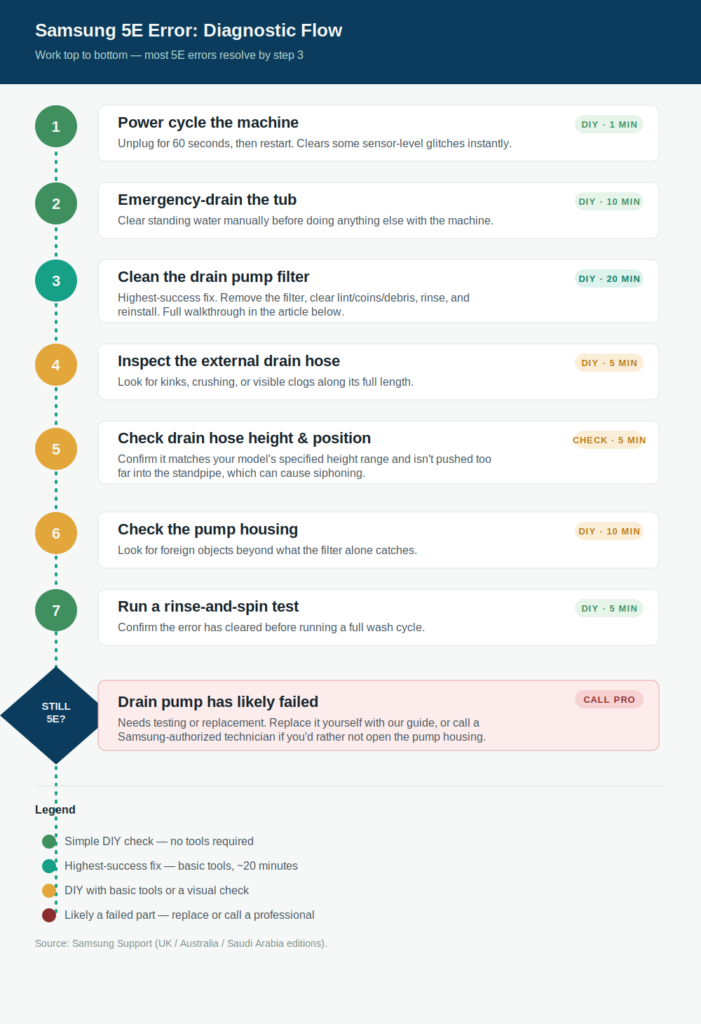
Work through these in order — most 5E errors resolve at step 3 or earlier:
- Power cycle the machine. Unplug it (or switch off the breaker) for a full minute, then restart. This alone resolves a portion of 5E errors caused by a sensor misread. For the full power-cycling procedure on any washer, see How to Reset a Washing Machine.
- Emergency-drain the tub first. If there’s standing water, drain it manually before doing anything else — running more cycles with water already in the drum isn’t recommended.
- Clean the drain pump filter. This is the highest-success fix and is covered step by step below, or in our dedicated guide: How to Clean a Washing Machine Drain Filter.
- Inspect the external drain hose. Look for kinks, crushing, or visible clogs along its length.
- Check the drain hose height and positioning. Confirm it matches your model’s specified height range and isn’t pushed too far into the standpipe, which can cause siphoning.
- Check for foreign objects in the pump housing beyond what the filter catches, if you’re comfortable accessing it.
- Run a rinse-and-spin cycle to confirm the error has cleared before doing a full wash.
- If the error persists, the drain pump itself has likely failed and needs testing or replacement — at this point, most owners are better served either replacing the pump themselves (see How to Replace a Washing Machine Drain Pump) or calling a Samsung-authorized technician.
DIY Tutorial: Emergency Draining and Cleaning the Pump Filter
This is the single highest-success DIY fix for the 5E error, and it takes about 20 minutes:
- Unplug the washer and place towels on the floor in front of the access panel.
- Open the small access door at the bottom front of the machine, using a coin or your hand depending on the model.
- Pull out the emergency drain hose, remove its cap, and let the water drain into a shallow container. This can take several minutes on a full tub.
- Once drained, reattach the cap and secure the emergency hose back in its holder.
- Turn the drain filter counterclockwise to remove it fully.
- Clear out any lint, coins, buttons, or debris from the filter and the filter housing opening.
- Rinse the filter under running water and inspect the impeller (visible through the filter opening) for anything caught in the blades.
- Reinsert the filter and turn it clockwise until snug — don’t overtighten.
- Close the access door and run a short rinse-and-spin cycle to confirm normal drainage.
Replacement Parts You Might Need
If cleaning the filter and checking the hose don’t resolve the 5E error, these are the most commonly replaced parts:
- Drain pump — the most frequent actual part failure behind a persistent 5E error; our dedicated guide walks through the full swap: How to Replace a Washing Machine Drain Pump.
- Drain hose — inexpensive to replace outright if a hose shows cracking, a permanent kink, or damage from age.
- Pressure/level sensor — less commonly the cause, but worth testing if the pump and hose both check out fine.
- Wire harness connectors — corrosion or a loose connection at the pump harness can mimic a pump failure and should be inspected before replacing the pump itself.
Always match parts to your exact model number rather than assuming a universal fit — Samsung’s official parts lookup by model number is the most reliable source.
Installation Specs That Prevent 5E Errors
Drain hose installation height matters more than most owners expect. Most Samsung front-load and top-load models specify the drain hose outlet sit within a defined height range above the floor — too low and the machine can’t build enough pressure to detect proper drainage; too high and the pump has to work harder and may trigger a fault under load. If your machine was recently installed, moved, or connected to a different standpipe, re-checking this height against your model’s manual is worth doing before assuming a part has failed.
Warranty Considerations
If your washer is still within Samsung’s warranty period, check your warranty terms before opening the pump housing or replacing internal parts yourself — unauthorized repair attempts can void coverage on some models. Filter cleaning, emergency draining, and hose inspection are standard homeowner maintenance and typically don’t affect warranty status, but pump replacement or internal component work usually should go through Samsung Support or an authorized technician while the unit is covered.
Preventing the 5E Error From Coming Back
- Clean the drain pump filter every one to three months, and immediately after washing anything with loose coins, tissues, or small items in pockets.
- Empty pockets before every load — this single habit prevents a large share of drain-related clogs.
- Inspect the external drain hose annually for kinks, cracking, or debris buildup.
- Avoid using excessive detergent; residue buildup inside the pump and hose contributes to clogs over time.
- For a full maintenance routine that also prevents fill-side errors and other common failures, see our The Complete Washing Machine Troubleshooting Guide.
FAQs
Is the Samsung 5E error dangerous to ignore? Not immediately dangerous, but leaving standing water in the drum for extended periods can encourage mold growth and put unnecessary strain on the pump if you keep restarting cycles. It’s worth resolving rather than repeatedly restarting and hoping it clears.
Can I fix the Samsung 5E error without calling a technician? Yes, in most cases. The majority of 5E errors are resolved by emergency-draining the tub and cleaning the drain pump filter — both doable with basic tools and no disassembly of the machine’s internals.
Why does my Samsung washer show 5E only on heavy loads? Larger loads push more lint and debris toward the pump filter in a single cycle, which can be enough to trigger a marginal clog into a full blockage. If 5E only appears on heavy or bulky loads, check and clean the filter first.
What’s the difference between the 5E and 5C codes? Both flag the same underlying drainage problem; the specific code shown depends on the model and control panel generation rather than indicating a different fault.
How do I know if it’s the pump and not just a clog? If you’ve emergency-drained the tub, cleaned the filter, checked the hose for kinks, and confirmed correct hose height, and the error still returns, the pump motor itself is the next most likely cause. A technician can confirm with a resistance test rather than guessing from symptoms alone.
Will unplugging my Samsung washer reset the 5E error? Often, yes, temporarily — a power cycle clears some sensor-level errors. But if the underlying blockage or part failure isn’t addressed, the error will return on a later cycle.
Is it normal for the control panel to lock after a 5E error appears? Yes. Many Samsung models disable button presses for a few minutes after a drain error as a built-in safety pause — this isn’t a separate malfunction, just wait it out before troubleshooting further.
Conclusion & Next Steps
A Samsung 5E error looks alarming on the display, but in the overwhelming majority of cases it comes down to a clogged filter or a kinked hose — both fixable in under half an hour with no special tools. Start with the emergency drain and filter cleaning in this guide, work through the hose and installation checks if the error persists, and only move to pump replacement or a technician call once you’ve ruled out the simple stuff.
If you’re dealing with more than one symptom, or you’re not sure whether this is really a 5E-specific issue, The Complete Washing Machine Troubleshooting Guide is the best place to cross-check against every other common washing machine problem. And if the filter cleaning in this guide fixes things today, bookmark How to Clean a Washing Machine Drain Filter and put it on a recurring reminder — a two-minute check every couple of months is the single best way to keep this error from coming back.