
Table of Contents
- What Does the Samsung 4E Error Mean? (Quick Answer)
- Symptoms of the Samsung 4E Error
- What Causes the Samsung 4E Error
- Safety Precautions Before You Start
- Related Samsung Error Codes
- Where to Find Your Samsung Owner’s Manual
- Step-by-Step: How to Fix the 4E Error
- DIY Tutorial: Cleaning the Inlet Mesh Screens
- Replacement Parts You Might Need
- Water Pressure Specs and Requirements
- Warranty Considerations
- Preventing the 4E Error From Coming Back
- FAQs
A Samsung washing machine’s 4E (or 4C) error means the machine has detected a water supply problem — it isn’t receiving enough water fast enough to start or continue a cycle. It’s almost always caused by a closed or partially open wall valve, a kinked supply hose, or a clogged inlet mesh screen, not a serious mechanical failure. If you’re troubleshooting a Samsung washer for the first time, our full The Complete Washing Machine Troubleshooting Guide covers every symptom this machine can throw at you, not just this one code.
Symptoms of the Samsung 4E Error
The 4E error rarely shows up alone — watch for these accompanying signs:
- The display shows 4E or 4C, and the cycle pauses or refuses to start.
- The tub fills very slowly, partially, or not at all before the error appears.
- The drain pump may run briefly even though little or no water has entered the tub.
- The error can appear consistently on every cycle, or intermittently, depending on whether the cause is a full blockage or a pressure issue.
- On some models, the error clears temporarily after a power cycle but returns partway through the next wash.
What Causes the Samsung 4E Error
The 4E error is a water supply fault, and the causes almost all trace back to something between the wall and the tub:
- Wall valves closed or only partially open — the single most common cause. Both the hot and cold shut-off valves behind the machine need to be fully open.
- Kinked, twisted, or damaged supply hoses — especially likely if the washer was recently moved or installed.
- Clogged mesh inlet screens — small filters inside the hose connection points trap sediment and mineral buildup over time and are a very common culprit on older installations.
- Low household water pressure — Samsung specifies the incoming water pressure needs to fall between roughly 0.5 and 8 bar; pressure below that range can trigger the same fault as a physical blockage.
- Only one hose connected without a splitter — some installations only run cold water to the machine; without a Y-splitter feeding both the hot and cold inlets, certain models will throw a 4E error.
- Blocked detergent dispenser drawer — this is more specifically the 4C variant, caused by detergent buildup restricting water flow through the dispenser.
- Failed water inlet valve or pressure switch — a less common but real possibility if every supply-side check comes back clean; this typically requires a multimeter test and, often, professional repair.
Safety Precautions Before You Start
- Unplug the washer or switch off its breaker before disconnecting any hoses or opening a panel.
- Turn off both wall shut-off valves before disconnecting hoses to avoid a surprise spray of pressurized water.
- Keep a towel or shallow pan handy — hoses hold residual water even after the valve is closed.
- If you get to the point of testing voltage at the water inlet valve, that step involves the machine powered on with an open panel; if you’re not comfortable working near live electronics, stop there and call a technician instead.
Related Samsung Error Codes
Samsung error codes are model-specific, so always confirm against your exact model, but a few show up alongside 4E often enough to be worth knowing:
- 4C — the dispenser-drawer variant of the same water-supply fault, usually resolved by cleaning the detergent drawer.
- 5E / 5C — the drainage counterpart to 4E; instead of a fill problem, it flags a drain problem. See our [Internal link: Samsung Washing Machine 5E Error] guide if you’re seeing standing water instead of a fill issue.
- UE — an unbalanced-load code, unrelated to water supply, but easy to confuse with 4E if you only glance at the display.
If none of these match what you’re seeing, the [Internal link: The Complete Washing Machine Troubleshooting Guide] has a full symptom-to-cause diagnostic table covering codes across every major brand.
Where to Find Your Samsung Owner’s Manual
Your exact model number (usually printed on a sticker inside the door frame or on the back panel) determines the precise inlet valve part, hose fitting type, and any model-specific troubleshooting screens. Samsung hosts manuals and parts diagrams by model number on its official support site — always confirm against your specific model rather than assuming every Samsung washer behaves identically, since features like the dispenser layout and inlet valve design vary across product lines.
Step-by-Step: How to Fix the 4E Error
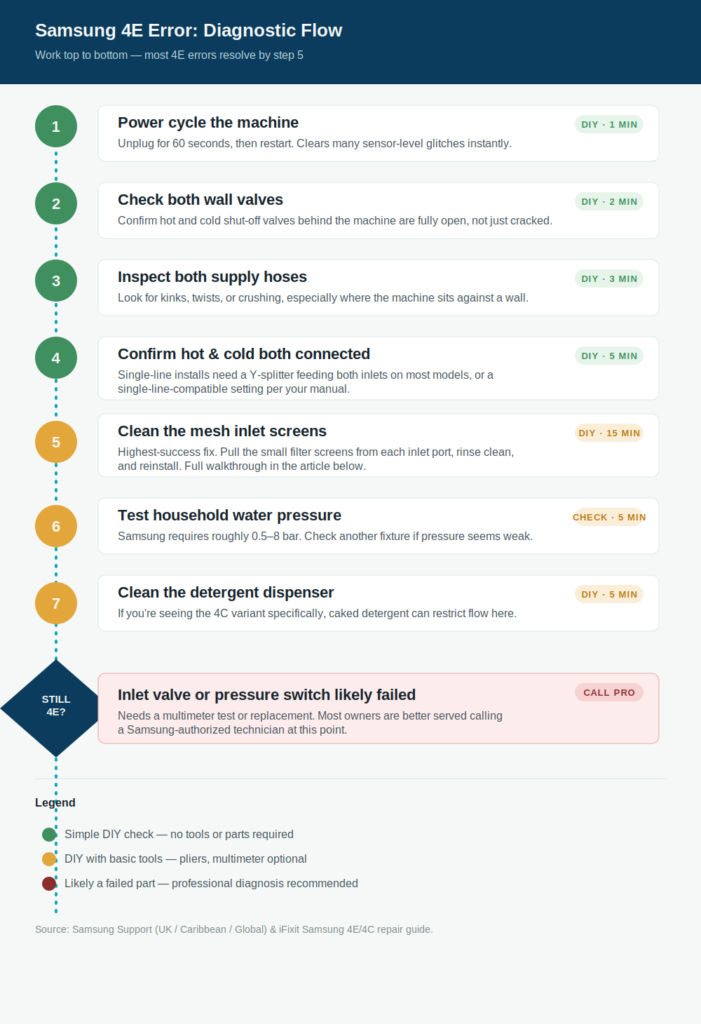
Work through these in order — most 4E errors resolve at step 3 or earlier:
- Power cycle the machine. Unplug it (or switch off the breaker) for a full minute, then restart. This alone resolves a surprising number of 4E errors caused by a momentary sensor glitch. If you want the full power-cycling procedure for any washer, see [Internal link: How to Reset a Washing Machine].
- Check both wall valves. Confirm the hot and cold shut-off valves behind the machine are turned fully open, not just cracked.
- Inspect both supply hoses. Look for kinks, twists, or crushing, especially near where the machine sits against a wall.
- Confirm both hot and cold connections are in use. If your installation only runs one supply line, install a Y-splitter so both inlets receive water, or check your model’s manual for single-line compatibility.
- Clean the mesh inlet screens. This is the most common actual fix — see the full walkthrough below.
- Check your household water pressure. Test another fixture in the house; if pressure is unusually low, the fault may be upstream of the washer entirely.
- Clean the detergent dispenser drawer if you’re seeing a 4C variant specifically.
- If the error persists, the water inlet valve or pressure switch has likely failed and needs testing with a multimeter or replacement — at this point, most owners are better served calling a Samsung-authorized technician unless they’re comfortable with appliance electrical testing.
DIY Tutorial: Cleaning the Inlet Mesh Screens
This is the single highest-success DIY fix for the 4E error, and it takes about 15 minutes:
- Unplug the washer and turn off both wall shut-off valves.
- Move the machine forward enough to access the back panel and hose connections.
- Disconnect the hot and cold supply hoses from the back of the machine, keeping a towel underneath to catch residual water.
- Using needle-nose pliers, gently pull the small mesh filter screens out of each water inlet port. They sit just inside the opening and can be delicate — work slowly.
- Rinse each screen under running water, working out any mineral buildup or sediment with a soft brush if needed.
- Reinsert the screens, reconnect the hoses (double-check hot goes to hot, cold to cold), and fully reopen both wall valves.
- Run a short test cycle to confirm the error has cleared.
Replacement Parts You Might Need
If cleaning and supply checks don’t resolve the 4E error, these are the most commonly replaced parts:
- Water inlet valve — the most frequent actual part failure behind a persistent 4E error; it’s a solenoid valve that can fail electrically or get stuck from mineral buildup.
- Supply hoses — inexpensive to replace outright if a hose shows cracking, bulging, or a kink that won’t straighten out.
- Pressure switch — less commonly the cause, but worth testing if the inlet valve checks out fine.
- Wire harness connectors — corrosion or a loose connection at the valve harness can mimic a valve failure; always inspected before replacing the valve itself.
Always match parts to your exact model number rather than assuming a universal fit — Samsung’s official parts lookup by model number is the most reliable source.
Water Pressure Specs and Requirements
Samsung specifies an incoming water pressure range of roughly 0.5 to 8 bar (about 7 to 116 psi) for normal operation. Pressure below that range — common in older homes, homes on well water, or homes with a failing pressure regulator — can trigger a 4E error even when every hose and valve is functioning correctly. If a plumber or pressure gauge confirms low household pressure, that’s a plumbing fix, not a washer repair.
Warranty Considerations
If your washer is still within Samsung’s warranty period, check your warranty terms before opening panels or testing the inlet valve yourself — unauthorized repair attempts can void coverage on some models. Supply-side checks like valve position, hose inspection, and screen cleaning are standard homeowner maintenance and typically don’t affect warranty status, but component-level testing or replacement usually should go through Samsung Support or an authorized technician while the unit is covered.
Preventing the 4E Error From Coming Back
- Clean the inlet mesh screens roughly twice a year, or more often if you’re on well water or have hard water.
- Avoid running the washer on plumbing systems with known low or fluctuating pressure without addressing the root cause first.
- Inspect supply hoses annually and replace them proactively every five years even if they look fine.
- Keep the detergent dispenser drawer clean and free of caked residue to prevent the 4C variant.
- For a full maintenance routine that also prevents drain-side errors, filter clogs, and other common failures, see our [Internal link: The Complete Washing Machine Troubleshooting Guide].
FAQs
Is the Samsung 4E error dangerous to ignore?
Not immediately dangerous, but running repeated cycles that fail to fill properly can strain the pump and control system over time. It’s worth resolving rather than repeatedly restarting the machine and hoping it clears on its own.
Can I fix the Samsung 4E error without calling a technician?
Yes, in most cases. The majority of 4E errors are resolved by checking wall valves, straightening hoses, and cleaning the inlet mesh screens — all doable with basic tools and no disassembly of the machine’s internals.
Why does my Samsung washer show 4E only on cold wash cycles?
This usually points to a supply-side issue specific to the cold line — a partially closed cold valve, a kinked cold hose, or a clogged cold inlet screen — rather than a general machine fault.
What’s the difference between the 4E and 4C codes?
Both flag a water supply problem, but 4C on many models specifically points to a blocked detergent dispenser restricting water flow, while general 4E covers valve, hose, and pressure issues more broadly. Check your model’s manual, since Samsung uses both codes somewhat differently across product lines.
Does low water pressure really trigger a 4E error?
Yes. Samsung’s specified operating range is roughly 0.5 to 8 bar, and pressure below that threshold can trigger the same fault code as a physical blockage, even with clean hoses and open valves.
How do I know if it’s the inlet valve and not just a clog?
If you’ve confirmed open valves, straight hoses, clean inlet screens, and adequate household pressure, and the error still returns, the inlet valve is the next most likely cause. A technician can confirm with a resistance/voltage test rather than guessing from symptoms alone.
Will unplugging my Samsung washer reset the 4E error?
Often, yes, temporarily — a power cycle clears a lot of sensor-level errors. But if the underlying cause (a closed valve, a clog, a failed part) isn’t addressed, the error will return on a later cycle.