
Table of Contents
- The short answer
- How a washing machine actually works
- Start here: identify your symptom
- The most common washing machine problems (and fixes)
- Decoding error codes across brands
- Safety rules before you touch anything
- DIY fix or call a pro?
- Preventive maintenance that stops repeat problems
- Replacement parts you might need
- How long should your washer last?
- Manuals and manufacturer resources
- FAQs
The Complete Washing Machine Troubleshooting Guide
The short answer
Most washing machine problems fall into six categories: won’t start, won’t fill, won’t drain, won’t spin, leaks, or excess noise/vibration. Roughly 80% of these are caused by something simple and fixable at home — a clogged filter, an unbalanced load, a kinked hose, or a tripped lid switch — not a failed motor or control board.
How a washing machine actually works
Every automatic washer runs the same basic cycle regardless of brand: it fills with water through an inlet valve, agitates or tumbles the load, drains through a pump and filter, then spins to extract water. A small computer (the control board) watches sensors at each stage — water level, door lock status, motor load, drum balance — and stops the cycle the moment something doesn’t match what it expects. That’s what an error code actually is: the machine telling you which sensor tripped, not that the machine is broken.
This matters because it reframes troubleshooting. Instead of guessing at “what’s wrong with my washer,” you’re really asking “which stage of the cycle failed, and why.” The rest of this guide is organized around exactly that.
Start here: identify your symptom
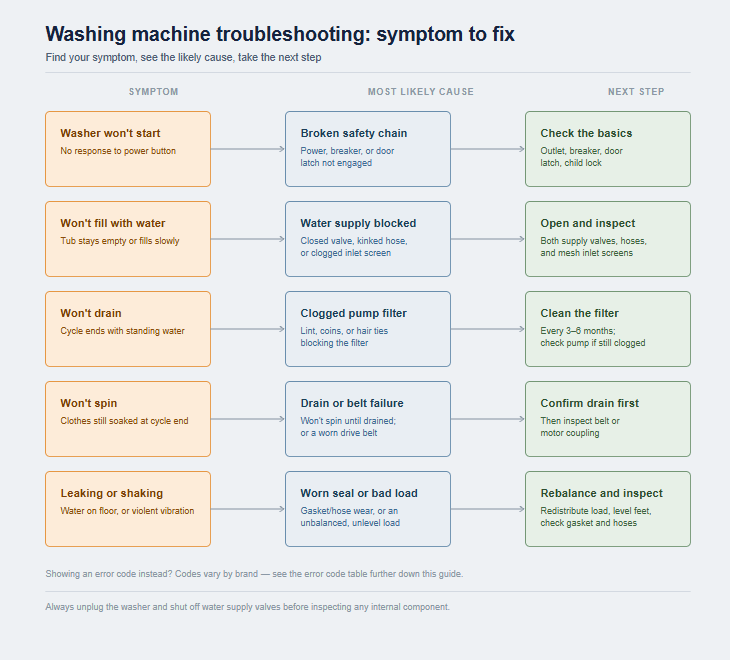
Before diving into causes, figure out where in the cycle things went wrong. The flow below maps the five most common entry points to their most likely cause — use it to jump straight to the right fix instead of troubleshooting blind.
The most common washing machine problems (and fixes)
For the full breakdown of all 15 issues with step-by-step fixes, see our companion guide: [Internal link: 15 Common Washing Machine Problems]. The summary below covers the ones that generate the most searches.
Washer won’t start Usually not a dead machine — it’s a broken safety chain. Check that the machine is fully plugged in, the breaker hasn’t tripped, the door or lid is latching completely (a worn door strike is a common culprit on front-loaders), and that you haven’t accidentally engaged a child lock or delay-start setting.
Washer won’t fill with water Almost always a water-supply problem, not an electrical one. Confirm both hot and cold supply valves behind the machine are fully open, check the inlet hoses for kinks or ice (a real issue in unheated laundry rooms in winter), and pull the mesh inlet screens where the hoses connect to the machine — these clog with sediment over years of use and are the single most overlooked fix in this category.
Washer won’t drain The number one cause, by a wide margin, is a clogged pump filter. Lint, coins, hair ties, and small socks collect there until water can no longer pass. For the full cleaning walkthrough, see [Internal link: How to Clean a Washing Machine Drain Filter]. If the filter is clear and the machine still won’t drain, the culprit is often a kinked or clogged drain hose, or — less commonly — a worn pump impeller that needs replacing (see [Internal link: How to Replace a Washing Machine Drain Pump]).
Washer won’t spin, or spins too slowly Often connected to the drain problem above — most machines won’t spin until they’ve drained successfully, since spinning a drum full of water is unsafe. If draining is confirmed fine, suspect a broken drive belt (top-loaders), a failing motor coupling, or a lid switch that isn’t registering as closed.
Washer is leaking Trace the water before you touch anything. Front-loaders most often leak from a worn door gasket or a detergent drawer overflowing with buildup; top-loaders more often leak from a cracked tub, a failing water inlet valve, or a loose hose clamp at the back. Overloading and using too much detergent both make leaks worse by pushing suds and water past seals that would otherwise hold.
Washer is shaking, banging, or “walking” Nine times out of ten this is an unbalanced load — bulky items like a single comforter or a pair of jeans bunch to one side of the drum. Stop the cycle, redistribute the load, and restart. If a balanced load still causes violent shaking, check that all four leveling feet are firmly on the floor and that the shipping bolts were removed after delivery (a surprisingly common miss on new installs).
Washer smells musty or moldy This is a front-loader signature complaint, caused by standing water and detergent residue in the door gasket and drum. Run a monthly hot-water cleaning cycle with washing-machine cleaner or plain white vinegar, wipe the gasket dry after each load, and leave the door cracked open between washes so the drum can air out.
Decoding error codes across brands
Error codes are not standardized — the same underlying problem shows up under a completely different code depending on the manufacturer. A water-supply fault, for example, displays as 4E on Samsung, IE on LG, and F8 E1 on Whirlpool, even though all three mean the same thing: the washer isn’t getting enough water. This inconsistency is the biggest source of confusion when people search for their exact code online.
Here’s how the major categories translate across brands:
| What actually failed | LG | Samsung | Whirlpool / Maytag |
|---|---|---|---|
| Water isn’t filling | IE | 4E / 4C | F8 E1 |
| Won’t drain | OE | 5E / 5C | F9 E1 |
| Load unbalanced | UE | UE / Ub | F0 E5 |
| Door/lid won’t lock | dE | dC | F5 |
| Motor overloaded or stalled | LE | E3 | LF |
For a full walkthrough on a specific code, jump to the dedicated guide: [Internal link: LG Washing Machine OE Error], [Internal link: LG Washing Machine UE Error], [Internal link: Samsung Washing Machine 4E Error], or [Internal link: Samsung Washing Machine 5E Error]. If your washer is completely unresponsive rather than showing a code, a simple reset often clears a stuck control board — see [Internal link: How to Reset a Washing Machine] before assuming a part has failed.
Safety rules before you touch anything
Washing machines combine water, electricity, and a motor capable of real torque, so a few non-negotiable rules apply to every fix in this guide and every linked article:
- Always unplug the washer before removing any panel or accessing the pump, motor, or wiring — never work on a machine that’s merely powered off at the control panel.
- Shut off both water supply valves at the wall before disconnecting any hose, to avoid a flooded laundry room.
- Never bypass a door lock or lid switch. These exist to stop the drum from spinning while it’s accessible, and defeating them is a serious injury risk.
- Stop immediately and call a professional if you notice a burning smell, scorched wiring, or water anywhere near an outlet or the control board.
DIY fix or call a pro?
As a rule of thumb: anything involving water supply, hoses, filters, leveling, load balance, or basic resets is safe DIY territory for most homeowners. Anything involving the control board, main bearing, motor windings, or internal wiring diagnostics is usually worth paying a technician for — both because of the safety risk and because misdiagnosing an electronic fault can turn a $150 repair into a $600 one. If you’ve worked through the relevant symptom section above, checked for the error code translation, and confirmed there’s no obvious blockage or supply issue, that’s typically the point to call a professional rather than keep guessing.
Preventive maintenance that stops repeat problems
Most washer service calls trace back to a small handful of neglected maintenance tasks:
- Clean the drain filter every 3–6 months. This single habit prevents the most common drain and odor complaints on this list. Full steps: [Internal link: How to Clean a Washing Machine Drain Filter].
- Run a hot cleaning cycle monthly, especially on front-loaders, to keep the gasket and drum free of detergent buildup and mold.
- Leave the door or lid cracked open between loads so the drum can dry out.
- Don’t overload the drum. A load that can’t tumble freely is the leading cause of both unbalanced-load errors and premature bearing wear.
- Inspect supply hoses annually for bulging, cracking, or corrosion at the fittings, and replace them every 5 years as a preventive measure regardless of appearance.
Replacement parts you might need
A handful of parts account for the majority of washer repairs, and most are inexpensive and accessible without a full technician visit:
- Drain pump — fails when it can no longer move water despite a clean filter; see [Internal link: How to Replace a Washing Machine Drain Pump].
- Door gasket / boot seal — the most common front-loader leak point after years of use.
- Water inlet valve — the usual fix when hoses and screens are confirmed clear but the machine still won’t fill.
- Drive belt — mainly on older top-loaders; a slipping or snapped belt shows up as weak or absent spin.
- Suspension springs/shocks — replace in pairs if a machine has developed excess vibration even with balanced, appropriately sized loads.
How long should your washer last?
Most washing machines are built to last roughly 10–14 years with normal use and basic maintenance, though this varies by brand and machine type. For a full breakdown of what shortens or extends that lifespan — and how to tell whether a repair or a replacement makes more financial sense — see [Internal link: How Long Does a Washing Machine Last?].
Manuals and manufacturer resources
If your machine’s specific model number matters for a fix (part compatibility, exact error code list, warranty status), your manufacturer’s official support site is the most reliable source — it will list every error code for your exact model along with the current owner’s manual for download. Keep your model and serial number handy (usually on a sticker inside the door or on the back panel) before you call for parts or service.
Frequently Asked Questions
Why does my washing machine stop mid-cycle for no reason?
This is almost always the control board catching a sensor mismatch — commonly an unbalanced load, a door that isn’t fully latched, or a drain that’s taking longer than the machine expects. Check the display for an error code first; if there isn’t one, redistribute the load and confirm the door is closed firmly before restarting.
Is it normal for a washing machine to smell bad?
No — a persistent musty smell means standing moisture and detergent residue have built up in the gasket or drum, usually on front-loaders. It’s fixable with a monthly hot cleaning cycle and leaving the door open between washes, not a sign the machine needs replacing.
Can I run my washer with an error code showing if I just need it done?
It’s not recommended. Error codes exist because a safety or mechanical condition was detected — running the machine anyway risks flooding, an incomplete unsafe spin, or compounding the underlying fault into a more expensive repair.
Why does my washing machine shake so violently during spin?
The leading cause is an unbalanced load, followed by unlevel feet and, for new installations, forgotten shipping bolts. If a properly balanced, level machine still shakes badly, worn suspension components are the likely next step.
How do I know if it’s cheaper to repair or replace my washing machine?
As a rule of thumb, if a repair costs more than 50% of a new machine’s price, or the washer is already past 10 years old, replacement is usually the better financial call. See [Internal link: How Long Does a Washing Machine Last?] for the full cost comparison.
Do all washing machine brands use the same error codes?
No. Codes are manufacturer-specific — the same underlying fault can appear as completely different letters and numbers across LG, Samsung, Whirlpool, and other brands. Always confirm the code against your specific brand rather than assuming it matches another manufacturer’s meaning.
What’s the very first thing I should check when my washer isn’t working?
Confirm it has power (plug, breaker, outlet), that the door or lid is fully latched, and that both water supply valves are open. These three checks resolve a surprising share of “broken” washer calls before any real troubleshooting begins.
Need More Information About Your Washing Machine Problem?
TechSolved provides helpful information, troubleshooting guides, and general tips to help you better understand common washing machine problems and error codes.
Visit www.techsolved.blog to explore more technology guides and helpful information. If your washing machine requires repair, electrical work, replacement parts, or professional diagnosis, please contact a qualified technician or the manufacturer’s authorized service provider.
TechSolved — Your Tech Solve Guide for helpful and informative technology content.