
Table of Contents
- How Long Does a Washing Machine Last? (Quick Answer)
- Average Lifespan by Machine Type
- Average Lifespan by Brand
- What Actually Shortens a Washer’s Lifespan
- Signs Your Washing Machine Is Near the End
- Repair or Replace? The 50% Rule
- Typical Repair Costs by Problem
- How to Extend Your Washer’s Lifespan
- Warranty Considerations
- Signs It’s Time to Call a Professional vs. Replace Outright
- Environmental and Efficiency Considerations
- FAQs
- Conclusion & Next Steps
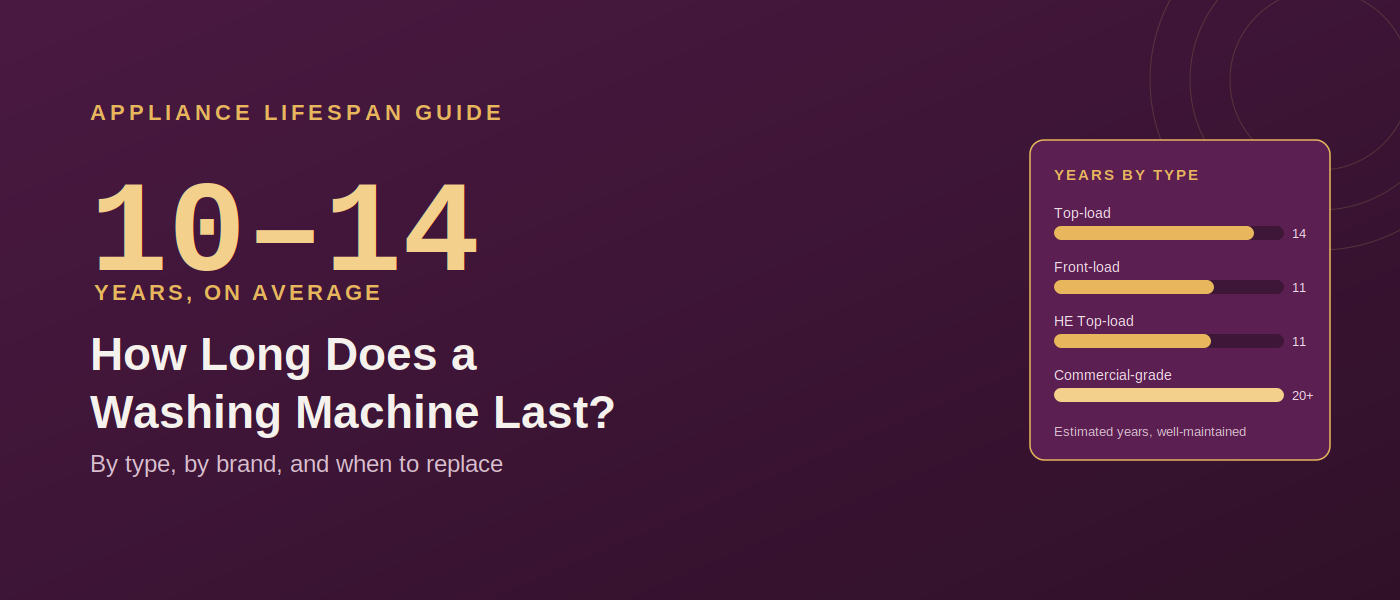
Most washing machines last 10 to 14 years with normal use and basic maintenance. Top-load washers tend to edge out front-load machines slightly — commonly 12 to 14 years versus 10 to 12 — thanks to simpler mechanics, though a well-maintained front-loader can easily last just as long. Heavy-duty residential brands built on commercial-grade components, like Speed Queen, are frequently rated for 20-plus years, well above the industry average.
Average Lifespan by Machine Type
Lifespan varies meaningfully by washer type, mostly due to mechanical complexity:
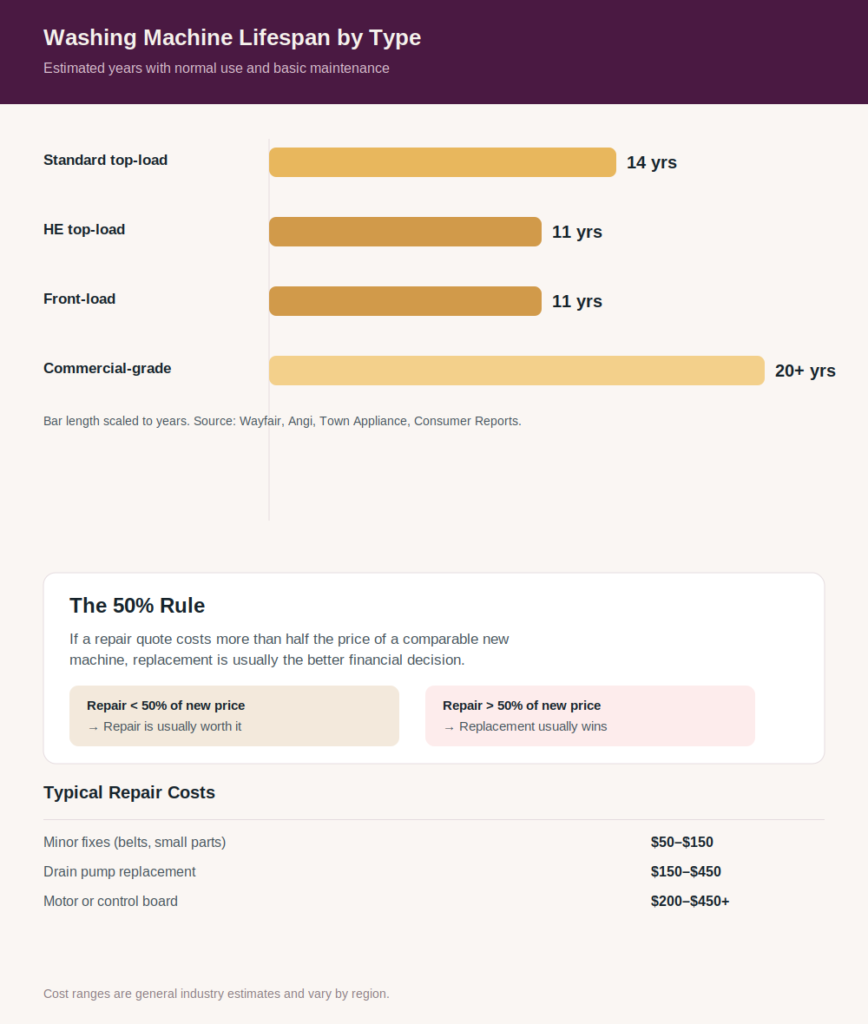
- Standard top-load washers (agitator-style): around 14 years on average — simpler mechanics and fewer parts prone to failure make these the most durable common configuration.
- High-efficiency (HE) top-load washers: around 11 years — the more complex drive systems and sensors that enable efficiency gains come with more components that can eventually wear out.
- Front-load washers: around 10 to 12 years — front-loaders are more prone to door-seal mold and gasket wear, though consistent maintenance (leaving the door open, cleaning the seal) closes much of this gap.
- Heavy-duty/commercial-grade residential washers (e.g., Speed Queen): frequently rated for 20-plus years, built with metal components more typical of commercial machines.
Average Lifespan by Brand
Brand-level differences exist, though they’re less dramatic than the type-level differences above, and any brand’s real-world lifespan depends heavily on your specific model and how well it’s maintained:
- Speed Queen stands out specifically for durability, using commercial-quality components in its residential lineup and backing that with longer warranties (commonly 3 years on mechanical-control models, 5 years on electronic-control models) than the roughly one-year standard elsewhere in the industry.
- ASKO is another brand frequently cited for long service life, with some estimates reaching around 20 years.
- Whirlpool, Maytag, Samsung, LG, and GE are commonly cited among the more reliable mainstream brands, generally landing within the standard 10–14 year range with proper care.
- Budget-oriented brands (entry-level models across several manufacturers) tend to land at the shorter end of the range or below it, reflecting lighter-duty components at a lower price point.
Because lifespan estimates vary across sources and specific models within a brand’s lineup differ, treat brand comparisons as a general directional signal rather than a guarantee for any individual machine.
What Actually Shortens a Washer’s Lifespan
- Frequency of use — a machine running multiple loads daily wears out faster than one used a few times a week.
- Overloading — consistently overstuffing the drum stresses the motor, bearings, and suspension components.
- Skipped maintenance — neglecting filter cleaning, hose inspection, and seal care accelerates wear and increases the odds of a failure cascading into a bigger repair.
- Excess detergent — residue buildup strains the pump and clogs components over time.
- Water quality — hard water accelerates mineral buildup in valves, hoses, and the pump.
- Installation issues — an unlevel machine or improperly installed hoses puts uneven stress on suspension components from day one.
Signs Your Washing Machine Is Near the End
Watch for a cluster of these symptoms rather than a single one-off issue:
- Unusual noises — grinding, banging, or loud humming that wasn’t there before.
- Failure to start or complete cycles consistently, even after basic troubleshooting.
- Water leaks that recur even after replacing hoses or seals.
- Clothes coming out excessively wet, unclean, or still soapy after a normal cycle.
- Repairs becoming more frequent, even if each individual fix is minor.
- The machine is already past the average lifespan for its type and a meaningful repair is now needed.
Repair or Replace? The 50% Rule
A widely used guideline in the appliance repair industry is the 50% rule: if a repair estimate comes in at more than half the cost of a comparable new machine, replacement is usually the better financial decision. A few things to weigh alongside that rule of thumb:
- Age relative to average lifespan — a costly repair on a 3-year-old machine is a very different decision than the same repair on a 12-year-old one.
- Repair history — a machine that’s needed several repairs in the past year or two is signaling more trouble ahead, even if today’s specific fix is affordable.
- Efficiency gains — a much older machine may cost more to run than a newer, more efficient model, which can offset some of the sting of replacement cost over time.
- Sentimental or budget constraints — the math isn’t the only factor; a repair that buys another year or two can still be the right call if replacement isn’t feasible right now.
Typical Repair Costs by Problem
Repair costs vary by region and technician, but general ranges commonly cited across the industry:
| Repair Type | Typical Cost Range |
|---|---|
| Minor fixes (belts, small parts) | $50–$150 |
| Drain pump replacement | $150–$450 (parts + labor) |
| Motor or control board replacement | $200–$450+ |
| Professional labor rate | $50–$150 per hour |
If you’re comfortable tackling the repair yourself, several common fixes — including drain pump replacement — cost significantly less in parts alone; see our guide: How to Replace a Washing Machine Drain Pump.
How to Extend Your Washer’s Lifespan
- Clean the drain filter every one to three months.
- Wipe down the door seal and leave the door open between loads on front-load machines to prevent mold.
- Inspect supply hoses annually and replace them proactively every five years regardless of appearance.
- Avoid overloading the drum, and use the correct detergent type and amount for your machine.
- Level the machine properly during installation and re-check periodically, since an unlevel washer accelerates suspension wear.
- Address small issues — a specific error code, a new noise — promptly rather than letting them compound into a larger failure.
Warranty Considerations
Most standard washing machines carry a one-year manufacturer warranty on parts and labor, sometimes with longer coverage on specific components like the motor or drum. Heavy-duty brands built for longevity, like Speed Queen, often extend warranty coverage well beyond the industry standard as a reflection of their expected service life. Always register your warranty and keep records of any professional repairs, since a documented repair history can matter both for warranty claims and for resale value if you sell the machine before it reaches end of life.
Signs It’s Time to Call a Professional vs. Replace Outright
Not every aging washer needs to be replaced immediately, but a professional opinion is worth getting when:
- You’re facing a repair estimate you can’t confidently evaluate against the 50% rule without a firm quote.
- The machine is showing multiple compounding symptoms rather than one isolated issue.
- You suspect a motor, control board, or drum-level failure rather than a simpler part like a hose or filter.
If the machine is well past its expected lifespan and facing a major repair, replacement is usually the more financially sound choice; if it’s relatively young and facing a single affordable fix, repair is almost always worth it. For symptom-specific troubleshooting before you call anyone, our 15 Common Washing Machine Problems guide covers the most frequent issues and what they usually mean.
Environmental and Efficiency Considerations
Newer washers, particularly Energy Star-certified models, commonly use meaningfully less water and energy than older units — some estimates cite roughly 25% less energy and 33% less water compared to standard models. For a machine already near end of life, this efficiency gap is worth factoring into a repair-versus-replace decision alongside the 50% rule, since a newer machine’s lower utility costs can partially offset its purchase price over time.
FAQs
What’s the average lifespan of a washing machine?
Most washing machines last 10 to 14 years, with top-load models generally landing at the higher end of that range and front-load models slightly lower, though both can exceed it with consistent maintenance.
Do front-load washers really last less long than top-load washers?
On average, yes, primarily due to door-seal mold and gasket wear rather than the drive mechanism itself. The gap narrows significantly with regular seal cleaning and leaving the door open between loads.
Is it worth repairing a 10-year-old washing machine?
It depends on the repair cost relative to the price of a new comparable machine. If the repair costs less than half of what a new machine would cost, repair is usually still worth it, even on a machine near the average lifespan.
Which washing machine brands last the longest?
Speed Queen is frequently cited for its commercial-grade components and above-average lifespan, often rated 20-plus years, with ASKO also commonly mentioned. Most mainstream brands land within the standard 10–14 year range.
How can I tell if my washer’s problem is a simple fix or a sign it’s dying?
A single isolated symptom, like one error code or one strange noise, is often a simple fix. Multiple compounding issues, or repairs becoming more frequent over a short period, are stronger signals the machine is nearing end of life.
Does regular maintenance really make a measurable difference in lifespan?
Yes. Filter cleaning, hose inspection, seal care, and avoiding overloading are consistently cited across manufacturers and repair sources as meaningfully extending a washer’s service life, often the difference between hitting the low end or high end of the average range.
Conclusion & Next Steps
There’s no single number that applies to every washing machine, but the range is consistent across sources: expect somewhere between 10 and 14 years from a well-maintained standard machine, with type, brand, and how well you care for it all shifting that number in either direction. The 50% rule is the simplest tool for the actual repair-or-replace decision when it comes down to it — and a little routine maintenance is the cheapest way to make sure you’re getting the long end of the range rather than the short end.
If your washer is showing symptoms right now and you’re not sure whether it’s a simple fix or a sign of something bigger, check our 15 Common Washing Machine Problems guide to match what you’re seeing to its likely cause, or start from the top with The Complete Washing Machine Troubleshooting Guide for the full picture before you decide anything.