
Table of Contents
- What’s Wrong With Your Washer? (Quick Answer)
- 1. Won’t Turn On
- 2. Won’t Fill With Water
- 3. Won’t Drain
- 4. Won’t Spin
- 5. Loud, Banging, or Vibrating
- 6. “Walking” or Bouncing During Spin
- 7. Leaking Water
- 8. Door or Lid Won’t Lock
- 9. Stops Mid-Cycle
- 10. Excessive Foam or Suds
- 11. Musty or Bad Smell
- 12. A Specific Error Code Appears
- 13. Clothes Come Out Still Dirty
- 14. Clothes Come Out Too Wet
- 15. Rattling or Grinding Noise
- When to Call a Professional
- Preventive Maintenance Checklist
- FAQs
- Conclusion & Next Steps
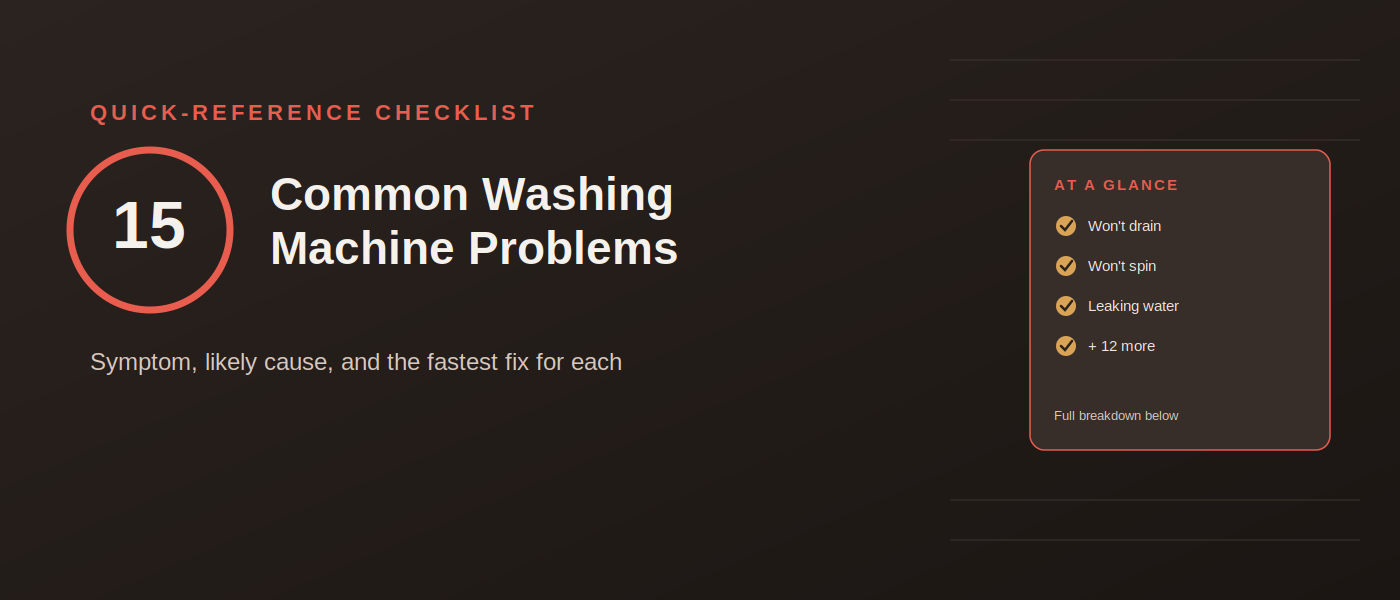
15 Common Washing Machine Problem
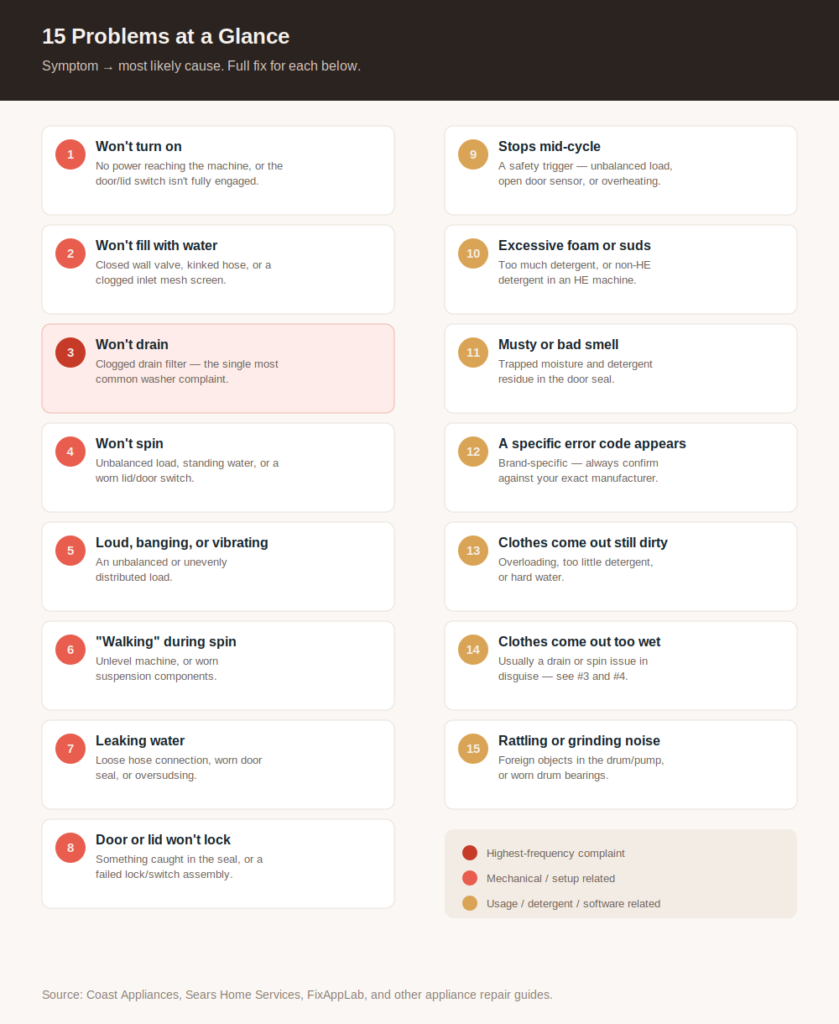
Most washing machine problems trace back to one of five root causes: a clogged filter or hose, an unbalanced or overloaded drum, a worn door or lid switch, too much detergent, or a genuinely failed part like a pump or motor. The 15 problems below cover the most common symptoms homeowners search for, what usually causes each one, and the fastest fix to try first.
1. Won’t Turn On
Likely cause: No power reaching the machine, a tripped breaker, or the door/lid switch not fully engaged — most washers won’t start with an open door. Quick fix: Confirm the outlet has power, check the breaker box, and make sure the door or lid is fully latched. If the machine hums but won’t start, the door lock switch itself may have failed.
2. Won’t Fill With Water
Likely cause: A closed or partially closed wall valve, a kinked supply hose, or a clogged inlet mesh screen. Quick fix: Confirm both hot and cold shut-off valves are fully open, check hoses for kinks, and unscrew the hoses to inspect the small mesh screens for mineral buildup.
3. Won’t Drain
Likely cause: By far the most common cause is a clogged drain pump filter; a kinked or clogged external hose is the second most common. Quick fix: Clean the drain filter — this single fix resolves the majority of drainage complaints. See our full walkthrough: How to Clean a Washing Machine Drain Filter.
4. Won’t Spin
Likely cause: An unbalanced load, standing water still in the drum, or a worn lid/door switch. Less commonly, a worn drive belt or failed motor coupling. Quick fix: Redistribute the load and confirm the machine has fully drained first — most “won’t spin” complaints are actually a drainage issue in disguise.
5. Loud, Banging, or Vibrating
Likely cause: An unbalanced or unevenly distributed load, most commonly with large or bulky items like comforters. Quick fix: Stop the cycle, redistribute the load evenly around the drum, and restart. If it happens on every load regardless of size, check the machine’s leveling next.
6. “Walking” or Bouncing During Spin
Likely cause: An unlevel machine is the most common cause; worn or disconnected suspension components are the next most likely if leveling doesn’t fix it. Quick fix: Use a bubble level on top of the machine and adjust the leveling feet. If the machine is level and still walks, inspect the suspension rods or shocks for wear.
7. Leaking Water
Likely cause: A loose hose connection, worn door seal/gasket, or degraded fill hose washers are the most common culprits; oversudsing from too much detergent can also force water out around the door. Quick fix: Start with the simplest cause — tighten hose connections at the wall and the machine — before inspecting seals and washers, which typically need replacing rather than repairing once worn.
8. Door or Lid Won’t Lock
Likely cause: Something caught in the door seal preventing a full close, or a failed door lock/lid switch assembly. Quick fix: Check for a stray sleeve or towel edge caught in the seal, and confirm the door is pushed fully closed. If it locks but the machine still won’t start, the switch assembly itself likely needs replacing.
9. Stops Mid-Cycle
Likely cause: A safety trigger — an unbalanced load, an open door sensor, or a motor overheating from repeated heavy use. Quick fix: If it happens consistently at the same point in every cycle, that repeatability points to a specific failing part rather than a one-off load issue, and it’s worth a full reset before further troubleshooting: How to Reset a Washing Machine.
10. Excessive Foam or Suds
Likely cause: Almost always too much detergent, or using regular (non-HE) detergent in a high-efficiency machine, which is designed to use far less water. Quick fix: Switch to an HE-rated detergent if you have a high-efficiency machine, and reduce the amount used — most people use more detergent than the machine actually needs.
11. Musty or Bad Smell
Likely cause: Trapped moisture and detergent residue in the door seal and detergent drawer, especially common on front-load machines. Quick fix: Wipe down the door gasket after each load, leave the door cracked open between washes, and run a monthly empty hot-water cleaning cycle.
12. A Specific Error Code Appears
Likely cause: Error codes are brand-specific and not standardized — the same letters can mean different things on different manufacturers. Quick fix: Confirm the code against your specific brand before troubleshooting. For a full symptom-to-cause breakdown across every major brand, see The Complete Washing Machine Troubleshooting Guide.
13. Clothes Come Out Still Dirty
Likely cause: Overloading the drum, using too little detergent, hard water reducing detergent effectiveness, or washing on a cycle/temperature that’s too gentle for the soil level. Quick fix: Avoid overloading, match detergent amount to your water hardness, and use a heavier-duty cycle for visibly soiled loads rather than defaulting to a quick or delicate setting.
14. Clothes Come Out Too Wet
Likely cause: This is almost always a drainage or spin problem rather than a separate issue — see problems 3 and 4 above. Quick fix: Clean the drain filter first, since a partial clog often reduces spin effectiveness without triggering a full “won’t drain” error.
15. Rattling or Grinding Noise
Likely cause: Foreign objects (coins, buttons, underwire) bouncing around the drum or caught in the pump, or, less commonly, worn drum bearings. Quick fix: Pause the cycle and check pockets and the drum for loose items; rotate the drum by hand to help a trapped object work its way toward the filter. A grinding sound with no loose items usually points to bearing wear, which typically needs professional diagnosis.
When to Call a Professional
Most of the problems above are safe, straightforward DIY fixes — filter cleaning, load redistribution, leveling, and hose checks all fall into this category. It’s worth calling a professional instead when you’re seeing:
- A persistent burning smell, sparking, or a breaker that won’t reset.
- Grinding noises that persist even with an empty, level, balanced drum.
- Repeated failures of the same repair, suggesting a deeper underlying issue.
- Any repair that would require you to work on internal wiring or the control board and you’re not comfortable doing so.
As a general rule of thumb, if a repair quote comes in at more than half the cost of a comparable new machine, replacement is usually the better financial decision.
Preventive Maintenance Checklist
A large share of the problems on this list are preventable with a small amount of routine care:
- Clean the drain filter every one to three months.
- Empty pockets before every load to prevent coin- and object-related clogs and rattling.
- Use the correct detergent type and amount for your machine and water hardness.
- Leave the door cracked open between loads on front-load machines to prevent odor and mold.
- Check and level the machine periodically, especially after moving it.
- Inspect supply and drain hoses annually, and replace them proactively every five years.
FAQs
What’s the single most common washing machine problem?
Drainage issues caused by a clogged drain pump filter are consistently the most frequently reported washing machine complaint across manufacturers and repair services, and also the easiest to fix yourself.
Why does my washing machine bounce around during the spin cycle?
Almost always an unlevel machine or an unbalanced load. Check the leveling feet with a bubble level first, then redistribute the load if leveling doesn’t resolve it.
Is it normal for a washing machine to smell?
A musty smell, especially on front-load machines, is common and usually caused by trapped moisture rather than a mechanical fault. Regular door-seal cleaning and leaving the door open between loads typically resolves it.
Why does my washer leave clothes still dirty?
Overloading, using too little detergent, and hard water are the most common causes. Avoid packing the drum too full and match your detergent amount to your water hardness.
Do all washing machine error codes mean the same thing?
No. Error codes are manufacturer-specific, so the same code can mean different things on different brands. Always check the code against your specific brand’s documentation.
When should I stop troubleshooting and call a professional?
When you notice a burning smell, sparking, a breaker that won’t reset, or a repair that would require opening internal wiring or the control board and you’re not comfortable doing so yourself.
Conclusion & Next Steps
Fifteen problems sounds like a lot, but in practice, the overwhelming majority of washing machine complaints trace back to a small handful of root causes — a clogged filter, an unbalanced load, too much detergent, or a machine that isn’t level. Work through the matching entry above before assuming you need a repair technician, and you’ll resolve most of these without spending a dollar on parts.
If you’re dealing with a specific error code or want the complete symptom-to-cause breakdown in one place, head to The Complete Washing Machine Troubleshooting Guide. And if nothing here seems to match what you’re seeing, a simple How to Reset a Washing Machine is always worth trying before anything else.