
Table of Contents
- Why Won’t My Washing Machine Spin? (Quick Answer)
- Symptoms That Point to a Spin Problem
- What Causes a Washing Machine Not to Spin
- Safety Precautions Before You Start
- Related Error Codes Tied to Spin Problems
- Where to Find Your Owner’s Manual
- Step-by-Step: How to Fix a Washer That Won’t Spin
- DIY Tutorial: Fixing the Two Most Common Causes
- Replacement Parts You Might Need
- When to Call a Professional
- Warranty Considerations
- Preventing Future Spin Problems
- FAQs
- Conclusion & Next Steps
A washing machine that won’t spin is most often reacting to an unbalanced or overloaded drum, an unlevel installation, or a door/lid switch that isn’t fully engaged — all simple, no-tools fixes. Less commonly, standing water from a drainage problem, a worn drive belt, or a failed motor coupling is blocking the spin cycle, which requires a closer look before you’ll know whether it’s a DIY fix or a job for a technician.
Symptoms That Point to a Spin Problem
A “won’t spin” complaint usually shows up as one of these patterns:
- Clothes come out of the cycle soaking wet instead of just damp.
- The drum doesn’t move at all during what should be the spin phase, even though earlier parts of the cycle ran normally.
- The machine hums or runs during spin, but the drum stays still or barely moves.
- Spin speed feels noticeably weaker than usual, rather than completely absent.
- The cycle pauses or stops entirely partway through, especially right before the spin phase.
- Loud noise (squealing, grinding, or clicking) accompanies a slow or absent spin.
What Causes a Washing Machine Not to Spin
Work through these roughly in order from most to least common:
- Unbalanced or overloaded load — the single most common cause. Many washers reduce or skip spin entirely when a load is badly off-balance, as a built-in safety protection.
- Door or lid not fully engaged — most washers require a confirmed door/lid lock signal before high-speed spin will start at all.
- Standing water from a drain problem — many washers won’t move into a full spin until they’ve drained completely, so a clogged filter or kinked hose can look exactly like a spin failure.
- An unlevel machine — this can cause the drum to wobble, and some models will reduce or interrupt spin as a result.
- Wrong cycle or spin setting selected — a low- or no-spin setting, selected by mistake, will produce exactly this symptom with no actual fault at all.
- Worn or broken drive belt — on belt-driven washers, a slipped or broken belt lets the motor run without turning the drum, sometimes with a squealing or clicking noise.
- Failed motor coupling — a small plastic part designed to fail before the transmission does on some models, disconnecting the motor from the drum.
- Worn drum bearings — usually accompanied by loud rumbling or grinding, and one of the more involved repairs on this list.
- Faulty pressure switch, inverter board, or control board — on newer machines with more electronic components, a bad sensor or board can block the spin cycle even when everything mechanical is fine.
Safety Precautions Before You Start
- Unplug the washer before opening any panel, checking a belt, or inspecting internal components.
- Stop and call a professional immediately if you notice a burnt smell, a tripped breaker that won’t reset, or loud grinding/banging — these are signs of a deeper issue that shouldn’t be run through repeatedly.
- Drain the tub first if there’s standing water, before attempting any further troubleshooting.
- Redistributing a load is always safe to try — it’s the simplest and lowest-risk step on this entire list.
Related Error Codes Tied to Spin Problems
Spin-related faults show up as different codes depending on brand, so always confirm against your specific manufacturer:
- UE / Ub (unbalanced load) — common on LG and Samsung machines specifically for this symptom.
- LE (motor error) — appears on some Samsung and LG models for motor-related spin faults.
- 5E / 5C, OE — drainage-related codes that can prevent a spin cycle from ever starting, even though the root cause isn’t the spin system itself. See our guide on Samsung Washing Machine 5E Error if that’s what you’re actually seeing.
If your machine isn’t showing a specific code but simply isn’t spinning, the causes above apply regardless of brand.
Where to Find Your Owner’s Manual
Your model number, typically on a sticker inside the door frame or on the back panel, determines your machine’s specific leveling procedure, drive system (belt-driven vs. direct-drive), and whether a given repair — like a motor coupling or drum bearing replacement — is something the manufacturer expects a homeowner to do or explicitly recommends a technician for. Manufacturer support sites host manuals and model-specific guidance that’s worth checking before attempting anything beyond the basic checks in this guide.
Step-by-Step: How to Fix a Washer That Won’t Spin
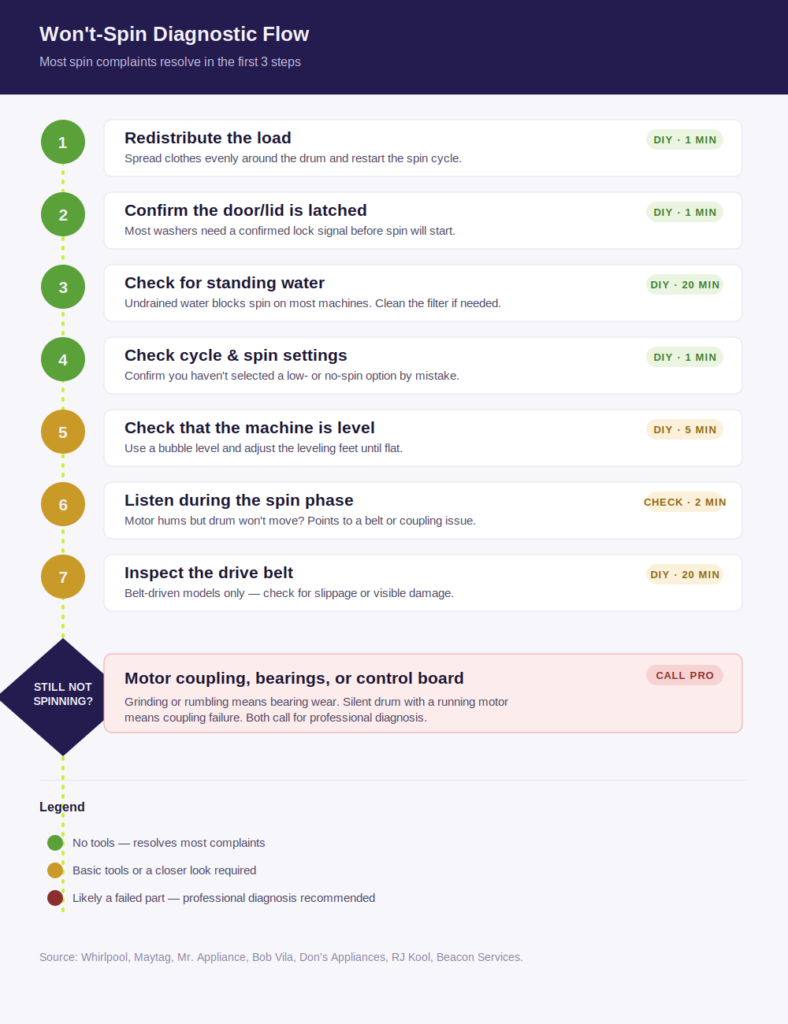
Work through these in order — the majority of spin complaints resolve in the first three steps:
- Redistribute the load. Open the door or lid, spread clothes evenly around the drum, close it, and restart the spin cycle.
- Confirm the door or lid is fully closed and latched. Most washers won’t spin without a confirmed lock signal.
- Check for standing water. If the tub hasn’t drained, clear the cause first — see How to Clean a Washing Machine Drain Filter for the single highest-success fix for drainage issues.
- Check your cycle and spin speed settings. Confirm you haven’t accidentally selected a low- or no-spin option.
- Check that the machine is level. Use a bubble level on top of the washer and adjust the leveling feet until it sits flat and stable.
- Listen during the spin phase. A motor that runs with no drum movement, or a squealing/clicking sound, points toward a belt or motor coupling issue.
- Inspect the drive belt (belt-driven models only) for slippage or visible damage, if you’re comfortable removing the back panel.
- If none of the above resolves it, the issue is likely a failed motor coupling, worn drum bearings, or a faulty pressure switch/control board — all of which typically call for professional diagnosis.
DIY Tutorial: Fixing the Two Most Common Causes
These two steps alone resolve the majority of “won’t spin” complaints, and both take just a few minutes:
Redistributing an unbalanced load:
- Pause or stop the cycle and open the door or lid.
- Manually spread clothing evenly around the drum, paying particular attention to heavy or bulky items like towels and bedding that tend to clump on one side.
- For consistently unbalanced loads, consider washing fewer heavy items together in a single load.
- Close the door or lid and restart or resume the cycle.
Leveling the machine:
- Place a bubble level on top of the washer, checking both side-to-side and front-to-back.
- Locate the adjustable leveling feet at the base of the machine.
- Adjust each foot (typically by turning it) until the level reads flat in both directions.
- Once level, gently rock the machine by hand to confirm it doesn’t wobble on any corner.
- Run a short test cycle to confirm the spin issue has resolved.
Replacement Parts You Might Need
If the simple checks above don’t resolve the issue, these are the most commonly replaced parts behind a persistent spin failure:
- Drive belt — a relatively inexpensive and moderate-difficulty replacement on belt-driven models.
- Motor coupling — a small, deliberately sacrificial part on some direct-drive models, designed to fail before more expensive components do.
- Lid/door switch — a common and usually affordable fix if the machine won’t confirm a closed door.
- Drum bearings — a more involved repair requiring drum disassembly; commonly estimated in the $200–$400 range including labor, and one of the better candidates for professional service given the complexity.
- Pressure switch or control/inverter board — on newer, more electronically complex machines, a faulty board or sensor can require specialized diagnosis.
When to Call a Professional
Some spin problems are safe, quick DIY fixes; others are worth handing off. Call a professional when:
- You hear loud grinding, rumbling, or banging that suggests worn drum bearings.
- The motor runs but the drum doesn’t move at all, suggesting a broken belt or motor coupling.
- You’ve ruled out load balance, door lock, drainage, leveling, and settings, and the machine still won’t spin.
- You notice a burnt smell or the breaker trips repeatedly.
- The repair would involve the control board, inverter board, or other electronic components you’re not comfortable diagnosing yourself.
Warranty Considerations
Basic troubleshooting — redistributing a load, checking settings, leveling the machine — is standard homeowner maintenance and never affects warranty coverage. If your washer is still under manufacturer warranty and the cause turns out to be a failed part like a motor, belt, or control board, check your warranty terms before attempting the repair yourself, since component-level repairs on a covered machine often need to go through an authorized technician to preserve remaining coverage.
Preventing Future Spin Problems
- Avoid overloading the drum, and try to keep heavy items like comforters and towels balanced with lighter items rather than washed alone in a full load.
- Re-check the machine’s level periodically, especially after moving it or if your floor isn’t perfectly rigid.
- Clean the drain filter every one to three months to prevent drainage-related spin interruptions — see How to Clean a Washing Machine Drain Filter.
- Double-check your cycle and spin settings before starting a load if you’ve recently changed presets or let someone else use the machine.
- Address minor noises or slow spin promptly rather than continuing to run cycles, since a slipping belt or a stressed bearing typically worsens with continued use.
FAQs
Why are my clothes still soaking wet even though the cycle finished?
This almost always means the washer skipped or reduced the final spin, usually due to load balance protection, a drainage issue, an incorrect spin setting, or a spin-system fault — not humidity or anything unrelated to the mechanics.
Can an unbalanced load really stop a washer from spinning entirely?
Yes. Many washers are designed to reduce or completely skip the spin cycle when a load is badly out of balance, specifically to protect the machine from damage.
Does my washer need to fully drain before it will spin?
On most machines, yes — spin typically won’t start (or won’t reach full speed) until the tub has drained, which is why a clogged filter or kinked hose can look exactly like a spin failure.
How do I know if it’s the belt or the motor?
If you hear the motor running (a hum) but see no drum movement at all, that points toward a broken or slipped belt or a failed motor coupling rather than a dead motor, which typically wouldn’t make any sound.
Is a washer not spinning always a big repair?
No. The majority of spin complaints are resolved by redistributing the load, confirming the door is closed, or leveling the machine — all free, tool-free fixes. Bigger repairs like drum bearings or a control board are real possibilities but are less common than the simple causes.
Why does my washer spin but leave clothes wetter than usual, rather than not spinning at all? This usually points to a partial cause rather than a full failure — a partially clogged filter reducing drain speed, a load that’s slightly unbalanced, or a spin speed setting lower than you intended, rather than a completely failed component.
Conclusion & Next Steps
A washing machine that won’t spin looks like a major repair, but in the majority of cases it’s one of the simplest problems on this entire site to fix — an unbalanced load, an unlatched door, or a machine that’s slightly out of level. Work through the checks in order, starting with redistributing the load and confirming the door is closed, before assuming you’re looking at a belt, motor, or bearing replacement.
If you’ve ruled out the easy causes and the machine still won’t spin, or if you’re hearing grinding or rumbling that suggests bearing wear, it’s a reasonable point to call a professional rather than keep guessing. And if you’re not sure this is really a spin-specific issue, our 15 Common Washing Machine Problems guide and the full guide The Complete Washing Machine Troubleshooting can help you cross-check against every other common symptom before you decide what to do next.