
Table of Contents
- What the UE error means
- Symptoms of the UE error
- What causes the UE error
- Safety first
- Related LG error codes
- Manuals and manufacturer resources
- Step-by-step troubleshooting
- Replacement parts you might need
- Specs: which LG models this affects
- Warranty considerations
- Maintenance to prevent UE errors
- DIY tutorial: rebalancing and leveling your washer
- FAQs
LG Washing Machine UE Error: What It Means & How to Fix It
Whether you searched for this as an LG washing machine showing UE or by its official name, you’re in the right place — this guide walks through exactly what the code means and how to clear it.
What the UE error means
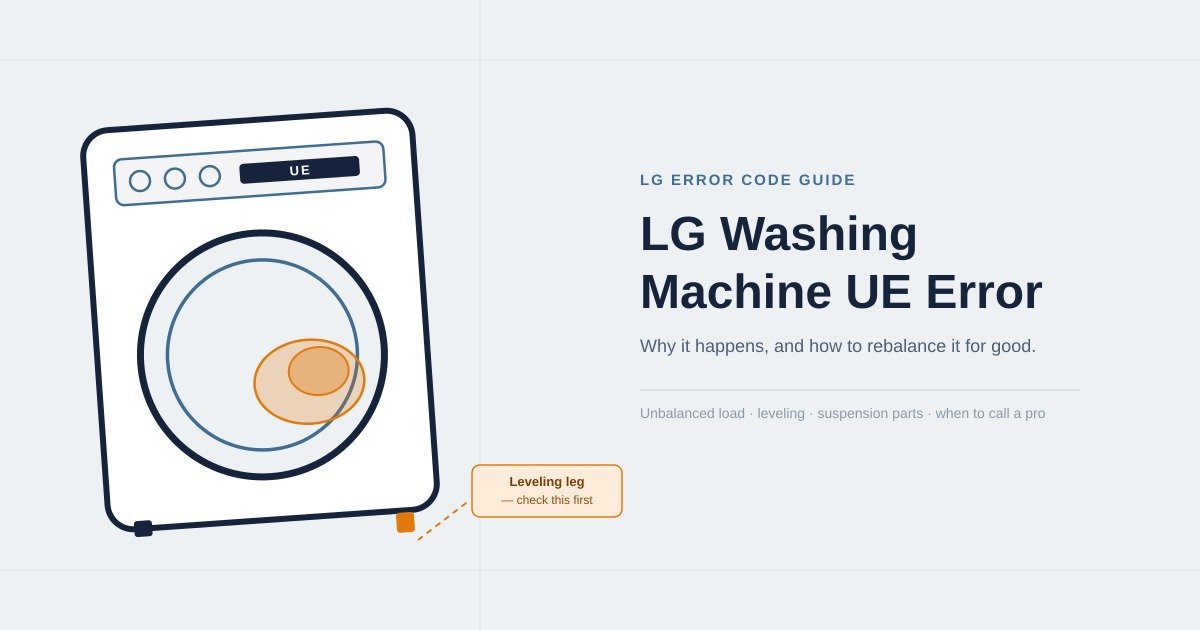
The UE error code on an LG washing machine means the machine’s sensors have detected an unbalanced load during the spin cycle and stopped spinning to prevent damage. The washer will try to redistribute the load itself first — if that fails after a few attempts, it displays UE and needs your help rebalancing the drum before it will finish the cycle. This is commonly known as the LG washer UE error code, and it simply means the load needs to be rebalanced before the washer can finish the cycle.
Symptoms of the UE error
- The display briefly flashes a lowercase “uE” while the washer attempts to self-correct, then switches to uppercase “UE” if it can’t.
- The washer will attempt to rebalance the load and flash the lowercase u uppercase E in the process, switching to the uppercase UE code only if unsuccessful after three attempts.
- The spin cycle stops early, or never reaches full speed, leaving clothes noticeably wetter than normal.
- You may feel or hear the washer thumping, rocking, or “walking” slightly just before the code appears.
- The error tends to show up more with very small loads (a single towel or pair of jeans) or very large, bulky ones (a comforter, a bath mat).
Together, these symptoms are the clearest indication you’re dealing with the LG washer UE error rather than a different fault code.
What causes the UE error
If your unit is displaying the LG washing machine error code UE, the cause is almost always one of the following.
Uneven load distribution. By far the most common cause. If the unit is displaying a UE error code, it typically means the laundry is unbalanced, and it’s worth first checking whether the load is too small. Certain cycles use less water during the wash and rinse stages, which can let clothes clump together or tangle instead of spreading out, making an unbalanced load more likely.
Load size mismatch — too small or too bulky. A single heavy item like one pair of jeans or one bath mat often can’t redistribute well enough to spin safely on its own, while oversized or absorbent items (comforters, pillows, foot mats) can shift all their weight to one side of the drum.
Washer not level. Even a properly loaded washer can throw a UE error if the machine itself isn’t level — during spin cycles the tub vibrates as it rotates, and an unlevel washer can’t compensate the way a level one can. Gently rocking the washer front-to-back and side-to-side should reveal minimal movement if it’s properly leveled.
Inappropriate items in the load. Some fabrics and household items don’t distribute weight evenly no matter how they’re arranged — pillows, cushions, foot mats, carpets, electric blankets, curtains, and rubber-backed mats are common offenders and can also damage the washer itself.
Worn suspension springs, rods, or shock absorbers. If a well-balanced, level load still triggers UE consistently, the drum’s internal suspension system may be at fault. Broken or worn shock absorbers or suspension rods can’t dampen the drum’s movement properly, causing the same imbalance symptoms even with normal laundry.
Worn drum bearings. Less common, but a worn bearing assembly can cause the drum to wobble or spin unevenly, often paired with a grinding or roaring noise — this is a more involved repair than the other causes on this list.
Safety first
- Never bypass the UE stop by forcing the drum to spin manually — it exists to prevent the machine from damaging itself or your floor.
- Unplug the washer before opening any panel to inspect suspension rods, shock absorbers, or the drum itself.
- If you need to access internal suspension components, you may need to remove the back panel or lay the washer on its side — get a second person to help, since front-load drums and washer cabinets are heavy and awkward to maneuver alone.
- Install non-skid pads if your laundry room floor is slippery enough that the washer moves during unbalanced spins, since a shifting appliance is a safety hazard independent of the UE code itself.
- If you notice grinding, metal scraping, water leaking near the drum, or a burning smell, stop and call a professional rather than continuing to run cycles.
Related LG error codes
If you’re trying to figure out what UE on washing machine LG models specifically refers to, the table below shows how it compares to other common codes.
| Code | Meaning |
| UE | Load is unbalanced during spin |
| OE | Draining problem — water isn’t leaving the drum |
| IE | Water supply is inadequate or water pressure is too low |
| dE | Washer lid or door isn’t closed properly |
| FF | The unit is frozen |
For the drain-specific code, see [Internal link: LG Washing Machine OE Error].
Manuals and manufacturer resources
LG’s official support library documents both the top-load “UE/Ub” and front-load “UE” variants of this code, since the underlying mechanism differs slightly between the two washer types. Have your model number ready (inside the door frame or on the back panel) before searching, since leveling-leg design and suspension access vary by model generation.
Step-by-step troubleshooting
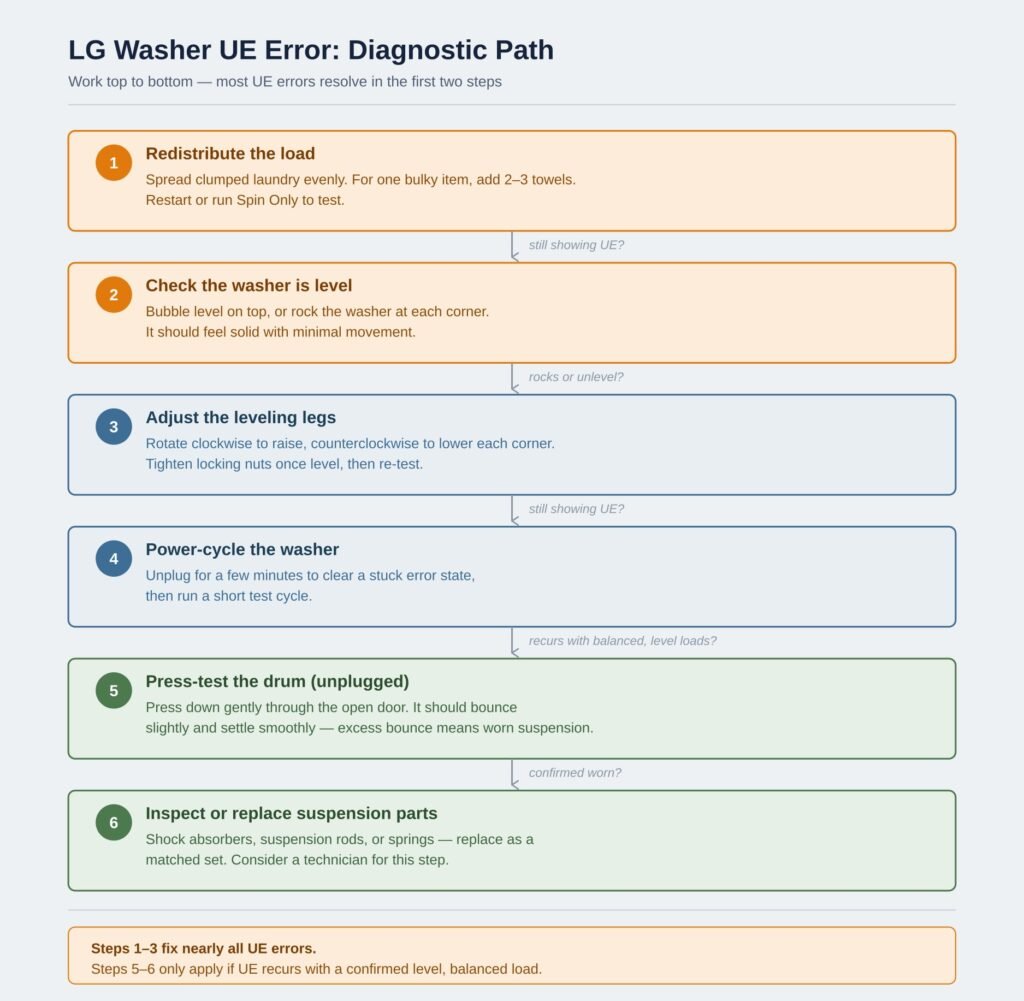
- Stop the cycle and redistribute the load. Open the door, spread clumped items evenly around the drum, and restart.
- Check the load size. If it’s a single bulky item, add two or three towels of similar weight to help it balance; if it’s overloaded, remove some items.
- Run a Spin Only cycle to test whether the rebalanced load spins normally — if it does, the problem was load-related and you’re done.
- Check that the washer is level. Use a bubble level on top of the unit, or gently rock it front-to-back and side-to-side — it should feel solid with minimal movement.
- Adjust the leveling legs if the washer rocks or the bubble isn’t centered (full steps in the DIY section below).
- Power-cycle the washer. Turn it off, unplug for a few minutes, then restart — this clears a stuck error state without addressing an underlying mechanical cause.
- Press down gently on the drum (washer unplugged, door open). It should bounce slightly and settle smoothly; a drum that feels loose or keeps bouncing suggests worn suspension components.
- Inspect suspension rods and shock absorbers if UE returns consistently even with balanced, level loads — this typically requires removing a back or front service panel.
- Replace worn suspension parts if visibly broken, detached, or leaking (shock absorbers can wear enough to leak fluid). Replace all shock absorbers together as a preventive measure even if only one has failed.
Replacement parts you might need
Leveling feet — inexpensive and the first thing to check if the washer rocks or won’t sit flat.
Suspension rods — support the tub in top-load washers and dampen movement in front-loaders; typically replaced as a full set of four for even tension.
Shock absorbers (front-load models) — dampen drum movement at the bottom of the tub; if one is worn or leaking, replace all of them together.
Suspension springs — hold the drum in place at the top of front-load washers; a stretched, broken, or detached spring lets the drum sag or move unevenly.
Drum bearing assembly — a more advanced and costly repair, only relevant if the drum itself wobbles or grinds independent of load or leveling.
Confirm exact part numbers against your specific model before ordering, since suspension hardware differs between top-load and front-load LG lines.
Specs: which LG models this affects
The UE error applies across both LG top-load washers (shown as UE or the related “Ub” code) and front-load washers, though the physical mechanism differs: top-load drums hang from suspension rods, while front-load drums are suspended by springs at the top and anchored by shock absorbers at the bottom. If your specific model shows “UE,” “uE,” or “Ub,” treat them as the same underlying unbalanced-load alert — the letter case and exact lettering vary slightly by model and cycle stage rather than indicating a different problem.
Warranty considerations
Redistributing a load, checking level, and adjusting the external leveling feet are routine homeowner tasks and won’t affect your warranty. Opening the cabinet to access suspension rods, shock absorbers, or the drum bearing assembly is more invasive, and attempting this yourself can void remaining warranty coverage on some models — plus working with heavy internal components without proper training carries real injury risk. If your washer is still under warranty and UE persists after confirming level and load, it’s worth having it inspected by an authorized technician before opening the cabinet yourself.
Maintenance to prevent UE errors
Load thoughtfully. Mix small and large items rather than washing one bulky piece alone, and avoid overloading beyond the recommended capacity.
Add a deep-rinse option on low-water cycles. On Cotton/Normal or Heavy Duty cycles, adding the fabric softener option shifts the rinse to a deeper fill, which spreads the load out more and reduces unbalanced spins.
Re-check level periodically, especially after moving the washer or after your home settles, since flooring can shift enough over time to throw off a previously level machine.
Avoid washing unsuitable items — pillows, foot mats, rubber-backed rugs, and similar items are common repeat offenders for triggering UE.
Use non-skid pads if your washer tends to walk on smooth flooring during spin.
DIY tutorial: rebalancing and leveling your washer
- Stop the cycle and open the door. Remove or redistribute laundry so it’s spread evenly around the drum rather than clumped to one side.
- Check the load size. For a single bulky item, add two or three towels of similar weight; for an overloaded drum, remove some items.
- Select “Spin Only” and start the cycle, watching the drum to see whether it now spins smoothly.
- If it still throws UE, check level. Place a bubble level on top of the washer, checking both side-to-side and front-to-back.
- Locate the leveling legs at the base of the washer — most can be rotated without lifting the machine.
- Adjust each leg by rotating clockwise to raise or counterclockwise to lower that corner, until the bubble is centered and all four feet contact the floor firmly.
- Tighten any locking nuts on the leveling legs once level, so the adjustment holds under vibration.
- Gently rock the washer front-to-back and side-to-side to confirm it feels solid with minimal movement.
- Run a short test cycle to confirm the UE error is resolved.
- If UE persists after a confirmed level, balanced load, unplug the washer and gently press down on the drum through the open door — excess bounce points to worn suspension parts and a repair beyond this basic tutorial (see the troubleshooting and parts sections above).
Frequently Asked Questions
Why does my LG washer keep showing UE even with a normal-sized load?
If a reasonably sized, evenly spread load still throws UE, check that the washer itself is level first, then consider whether a single heavy item is unbalancing on its own — adding a couple of towels to bulk out a single bulky piece often resolves it.
Is UE a sign my LG washer is broken?
Not usually. Most UE errors are load- or leveling-related and clear on the next cycle once redistributed. It’s only a sign of a real mechanical problem if it recurs consistently with balanced, level loads.
Can I just keep running Spin Only until the UE error goes away?
You can try it once after redistributing the load, but repeatedly forcing spin cycles on an unbalanced or unlevel washer adds unnecessary wear to the suspension system. If it doesn’t resolve within a try or two, check the load size and level instead.
How do I know if my washer is actually level?
Place a bubble level on top of the unit in both directions, or gently rock it at each corner — a level washer should feel solid with minimal rocking and all four feet should sit firmly on the floor.
Do I need to replace all four suspension parts if only one is worn?
Yes, replacing shock absorbers or suspension rods as a matched set is generally recommended, since mismatched wear levels between old and new parts can reintroduce imbalance even after the repair.
Can washing pillows or bath mats really cause a UE error?
Yes — items like pillows, foot mats, rugs, and rubber-backed mats don’t distribute weight evenly in the drum regardless of arrangement, and some can damage the washer itself, so they’re best avoided or hand-washed.
Will moving my washer to a new spot cause UE errors?
It can, if the new location isn’t level or the floor is slippery enough to let the washer shift during spin. Re-level the washer and consider non-skid pads any time you relocate it.